Sync contact fields. Segment people into lists. Personalize your website for Klaviyo contact segments.
Connect For FreeKlaviyo's sign-up forms handle the basics well: an overlay or flyout, an email field, subscribers landing on a list.
Where teams run out of road is triggering and targeting. Klaviyo's own top-ranking answer for custom-triggering a popup is a developer doc — which tells you most of what you need to know about how easy it is to fire a form on cart-add, or show a different offer to someone browsing a specific collection.
This guide covers building Klaviyo popups in ConvertFlow instead: same Klaviyo lists and profile properties, but with triggers, targeting and elements you'd otherwise need code for.
Worth being specific, because for a simple welcome popup Klaviyo's forms are genuinely fine and free.
Teams move when they need:
Browse ConvertFlow's popup template library and pick a design that matches your goal.
Click "Use this template" when you find one you like. Then, create a free ConvertFlow account, or log in if you have one already, to edit it.
We'll use a two-step email and SMS template:
👉🏽 Want inspiration first? See 6 email popups successful brands use.
Templates offer several formats. For a welcome offer, choose Overlay Popup.

You'll land in the drag-and-drop builder with the template ready to edit.

Styling works at two levels — theme level, which applies across every step and every element you add later, and element level, which overrides it.
Start with the theme. Click the "Theme" tab in the right-side panel.

Set buttons and they update across every step at once.

This is the first place the difference shows. In Klaviyo you style each element individually, which is manageable on a one-step form and tedious on a multi-step one.
This is the reason most people end up here. Trigger settings live in the "Settings" tab.
Add-to-cart and on-site message triggers aren't available in Klaviyo's form editor. The cart trigger is usually the highest-value one on an ecommerce store, because a shopper with something in their cart is a far better prospect than one who just landed.
Adjust how long the popup stays hidden after someone closes it.

Suppression doesn't apply to "upon click only", since that depends on the shopper's action.
Click any element and the side panel shows what you can change.

A free gift often outperforms a percentage discount, and doesn't train shoppers to wait for a code.

Click "Add element" to bring in things a Klaviyo form can't hold — a countdown timer, for instance.

Timers and product elements are the two that most change what a popup can do.
From your ConvertFlow dashboard, go to Settings → Integrations and connect Shopify.

The ConvertFlow script installs on your store automatically, and you can then pull product and cart data into campaigns.
Select the email form in the first step, click Manage Actions, then Manage integrations and find Klaviyo.

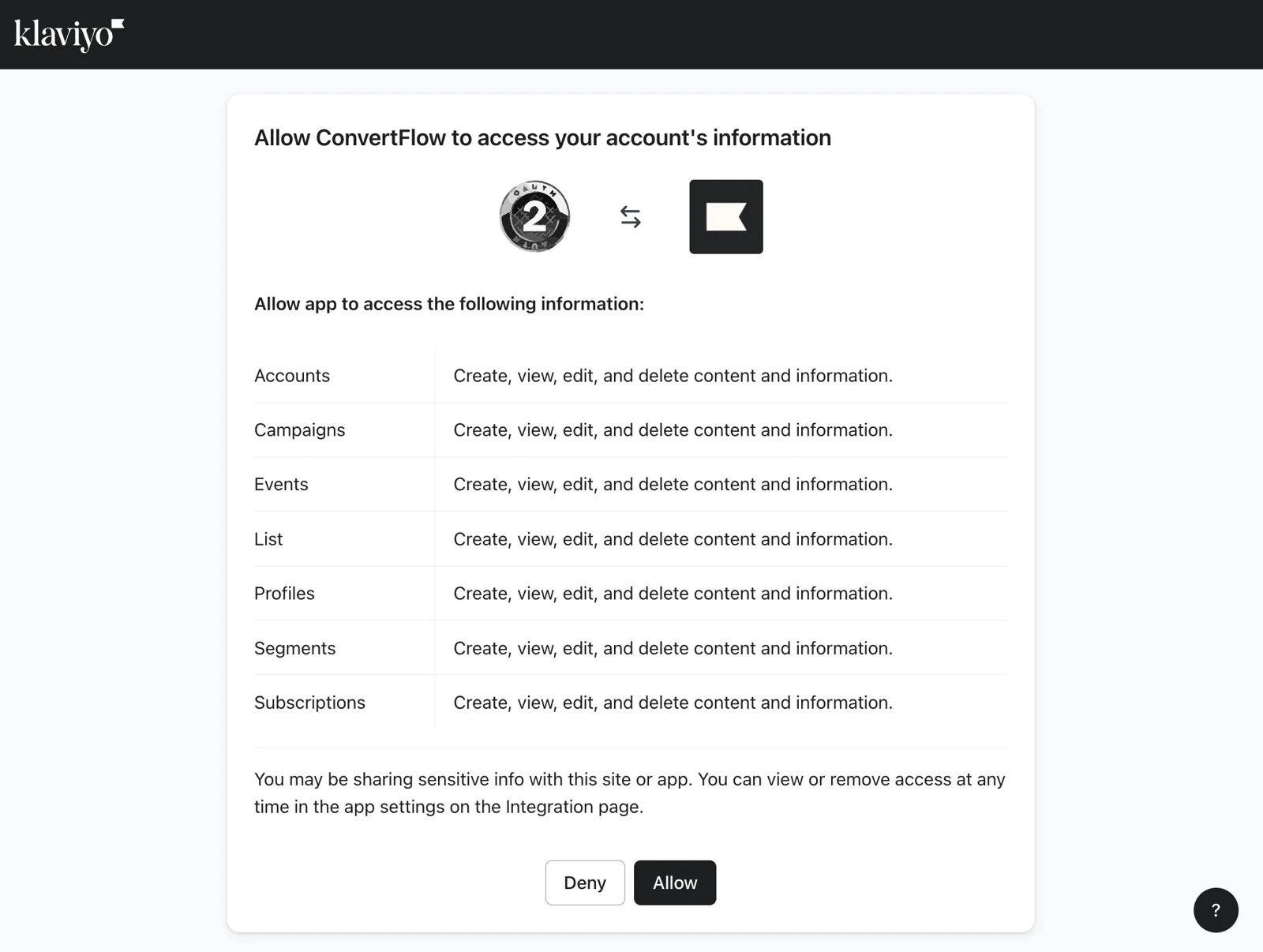
Grant ConvertFlow permission to access your Klaviyo account.
Back in Manage Actions, click Add automation.

Choose "Klaviyo — Add to list" and pick the list.

Repeat for the SMS form in step two, pointing it at your SMS list.
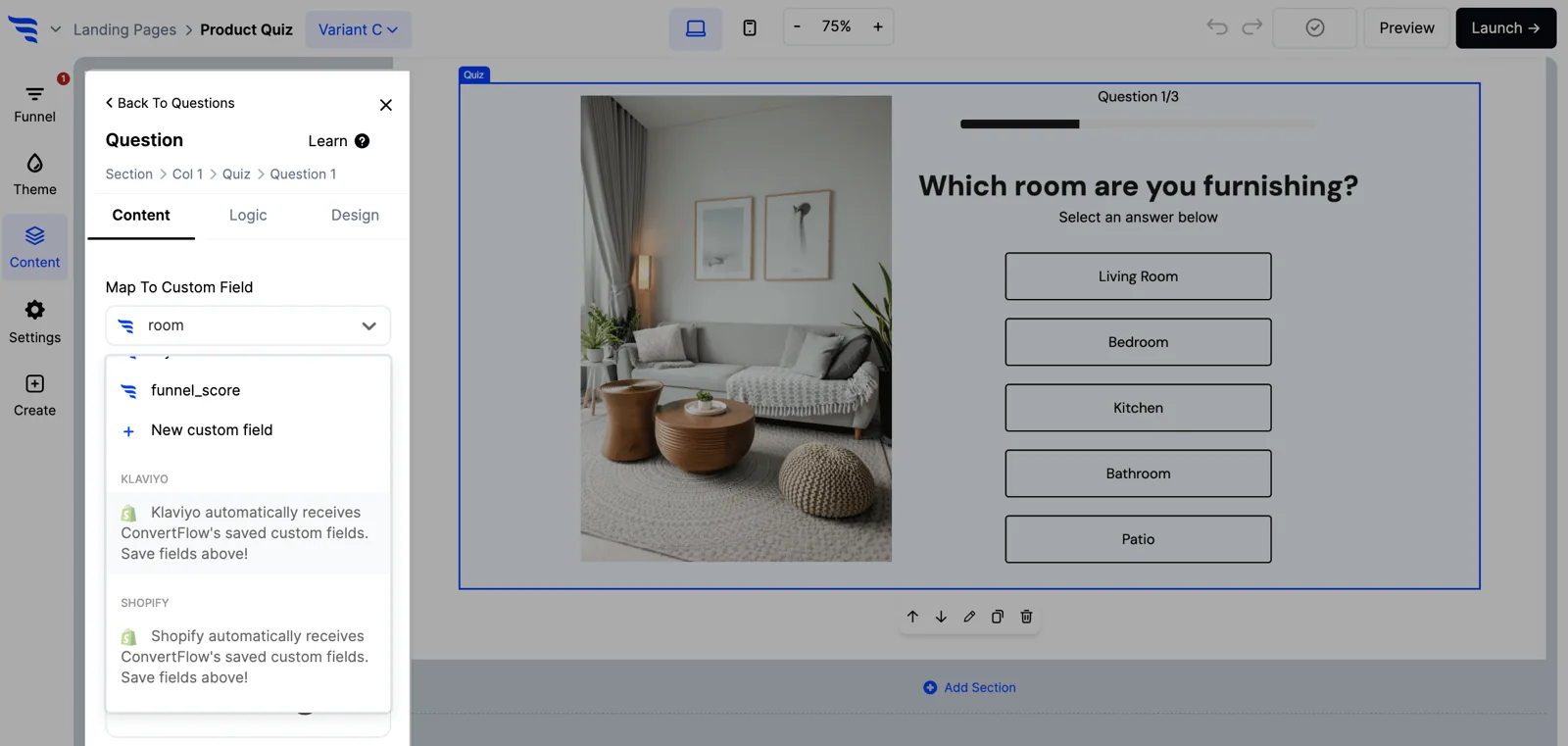
If your popup asks a question before the email field, map the answer to a Klaviyo profile property — either an existing one or a new one created from the builder.
Preset contact fields are mapped from the Fields button on your Integrations page.
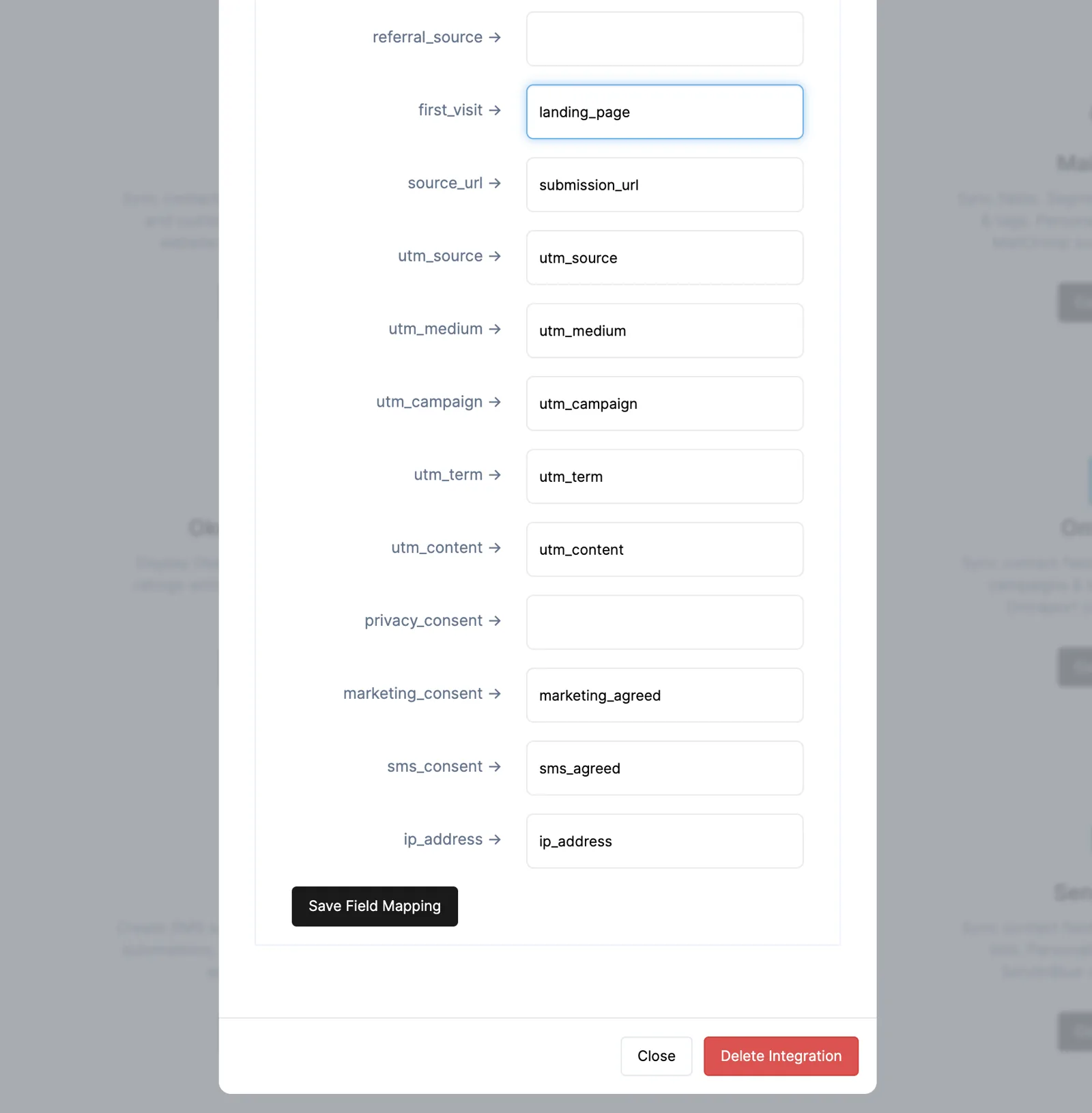
This is what turns a list of addresses into segments your flows can act on.
The final step of our template sends shoppers into a quiz.

Click the button, then Manage Actions.

In Klaviyo, a button can close the form or redirect to a URL. Here it can also jump to another funnel step or open a different campaign — which is how you chain a welcome popup into a product quiz rather than dead-ending on a discount code.
👉 No quiz yet? See how to build a product recommendation quiz.
Save and publish your changes, then click Preview.

The popup fires on the trigger you set and behaves as it will live — but automations don't run, so testing won't add your own address to a Klaviyo list.
Click Launch to control which pages and shopper segments see the popup.

Two things worth doing here that Klaviyo's targeting doesn't stretch to:
Collection-specific offers. Show a different popup on each collection or its product pages, so the offer speaks to what the shopper is actually browsing. We ran this with a DTC furniture brand and took welcome popup opt-in from 2.3% to 7.7% — a 235% lift — while collecting purchase-intent data for later campaigns.
Suppress subscribers, then show them something else. Exclude anyone already on your Klaviyo list, and give them a different offer instead — or a reminder of their unused first-purchase discount. Existing subscribers are your most frequent visitors, so this is a large share of impressions being wasted by default.
You can also target on site activity and Shopify data like cart value and cart contents.
Toggle the switch to go live.

Split-test unlimited variants and read views, conversions and attributed revenue per variant.
Most stores test headlines. On a Klaviyo popup, testing the trigger and the offer type usually moves the number further — exit-intent against cart-add, or a discount against a free gift.
Create a free account to build your Klaviyo popup.
Create a free ConvertFlow account and integrate
Klaviyo
in minutes.
Sync contact fields. Segment people into lists. Personalize your website for Klaviyo contact segments.
Connect For Free







.svg)