Klaviyo Flows: 12 Email Flow Examples From Top Ecommerce Brands
Klaviyo Flows: 12 Email Flow Examples From Top Ecommerce Brands
Klaviyo Flows: 12 Email Flow Examples From Top Ecommerce Brands
See 12 Klaviyo flow examples from HexClad, Grüns, IM8, Hims and more. Welcome flows, abandoned cart flows, and browse abandonment flows, with the setup behind each one.
If you're looking for Klaviyo flow examples, you’re in the right place. Most articles focus on flow setup, automation triggers, and technical configuration. What they rarely show is the actual strategy and messaging inside those flows.
That's a problem because the automation itself doesn't drive results. The emails inside the flow do.
Today’s top ecommerce brands use Klaviyo to deliver the right message at the right stage of the customer lifecycle.
Some flows introduce new subscribers to the brand, others educate prospects, recover abandoned carts, reinforce purchases, increase product adoption, or win back inactive customers. Every flow has a specific job to do.
To see what that looks like in practice, we analyzed real email flows used by leading ecommerce brands.
The examples you’ll see below reveal some of the most important ecommerce email flows, from customer acquisition and conversion to retention and repeat purchases.
In the next few minutes, you'll see:
→ How leading brands structure their Klaviyo flows
→ What types of emails appear inside successful flows
→ How welcome, educational, abandoned cart, onboarding, and recommendation flows work
→ What marketers can learn from each example
→ How to improve your own lifecycle marketing strategy
Whether you're building your first Klaviyo account or optimizing an existing one, these examples will show you how successful brands use email automation to move customers through every stage of the buying journey.
1. HexClad: Welcome email flow example
Flow type: Welcome flow
Goal: Convert new subscribers into first-time buyers through education, trust-building, product discovery, and incentives.
Where these emails appear: Automatically after someone subscribes to HexClad's email list through a popup, landing page, giveaway, or other lead capture form.
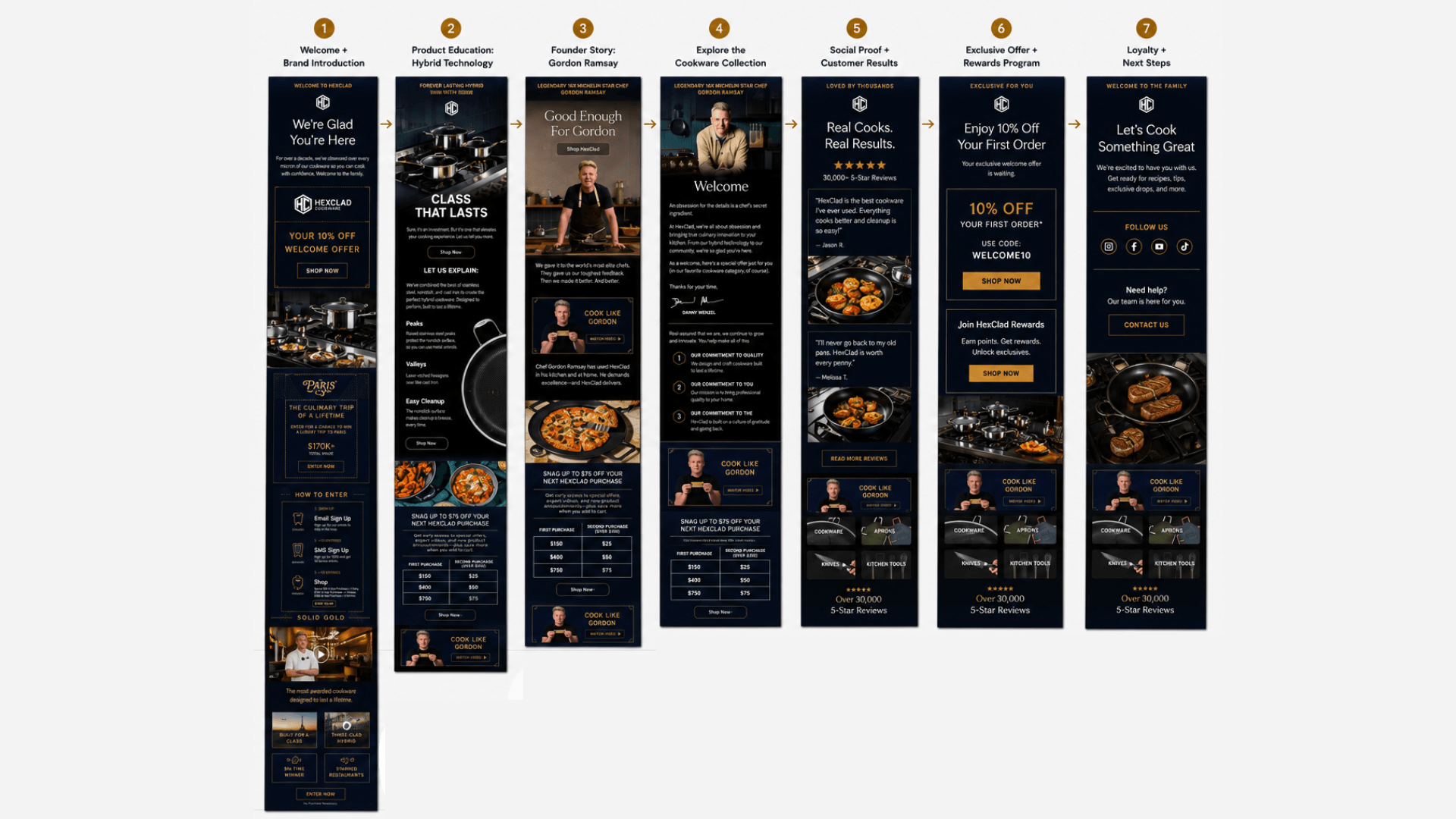
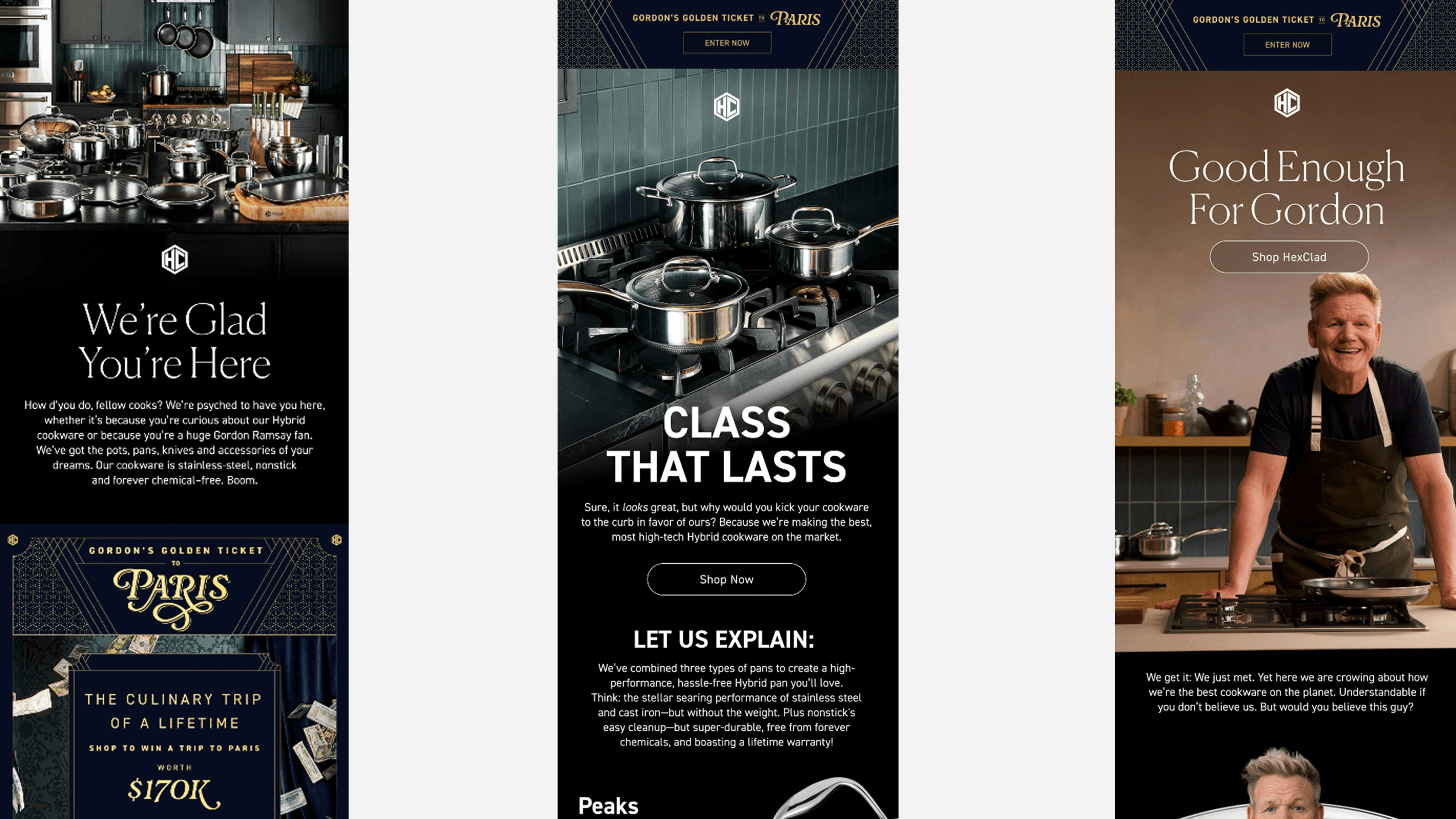
This infographic summarizes the structure and strategy behind the flow. Selected screenshots from the actual email sequence are shown below.
What they do
HexClad masterfully uses a multi-email welcome flow to introduce new subscribers to its products and move them toward a first purchase.
Instead of sending a single discount email, they deliver a sequence that combines product education, founder credibility, social proof, category discovery, and promotional offers.
The flow begins by welcoming subscribers and introducing the HexClad brand. From there, subscribers get educational emails explaining the company's hybrid cookware technology and how it’s different from run-of-the-mill nonstick and stainless-steel cookware.
HexClad’s welcome sequence also features well-known chef Gordon Ramsay, who serves as a brand ambassador and credibility builder throughout the flow. Additional emails showcase product categories, customer reviews, and exclusive subscriber incentives designed to encourage a first purchase.
Why it works
Most welcome flows focus almost entirely on discounts. HexClad focuses on building conviction before asking for the sale. Each email answers a different question a potential customer may have:
What makes HexClad different? Why should I trust the brand? Which products are right for me? What do other customers think? Is there an incentive to buy now?
By the time subscribers receive promotional emails, they've already been exposed to multiple trust-building touchpoints strategically designed to increase purchase intent.
Key takeaway
High-performing welcome flows don't repeat the same sales message. Instead, they create a sequence of emails that gradually build trust, educate buyers, and reduce uncertainty before presenting an offer. The result is a more informed subscriber and a stronger likelihood of conversion.
What marketers can learn
If you're building a Klaviyo welcome flow, consider structuring it similarly to HexClad’s:
✓ Brand introduction ✓ Product education ✓ Founder or brand story ✓ Product category discovery ✓ Social proof and reviews ✓ Promotional offer ✓ Loyalty or next-step engagement
Instead of relying on a single welcome email, use each email in the sequence to move subscribers one step closer to making a purchase.
2. IM8: Product education email flow example
Flow type: Product education flow
Goal: Move subscribers from awareness to consideration by building trust and credibility while showing how the product is different and better than the alternatives.
Where these emails appear: After a subscriber joins the IM8 email list and begins evaluating if the product is right for them.
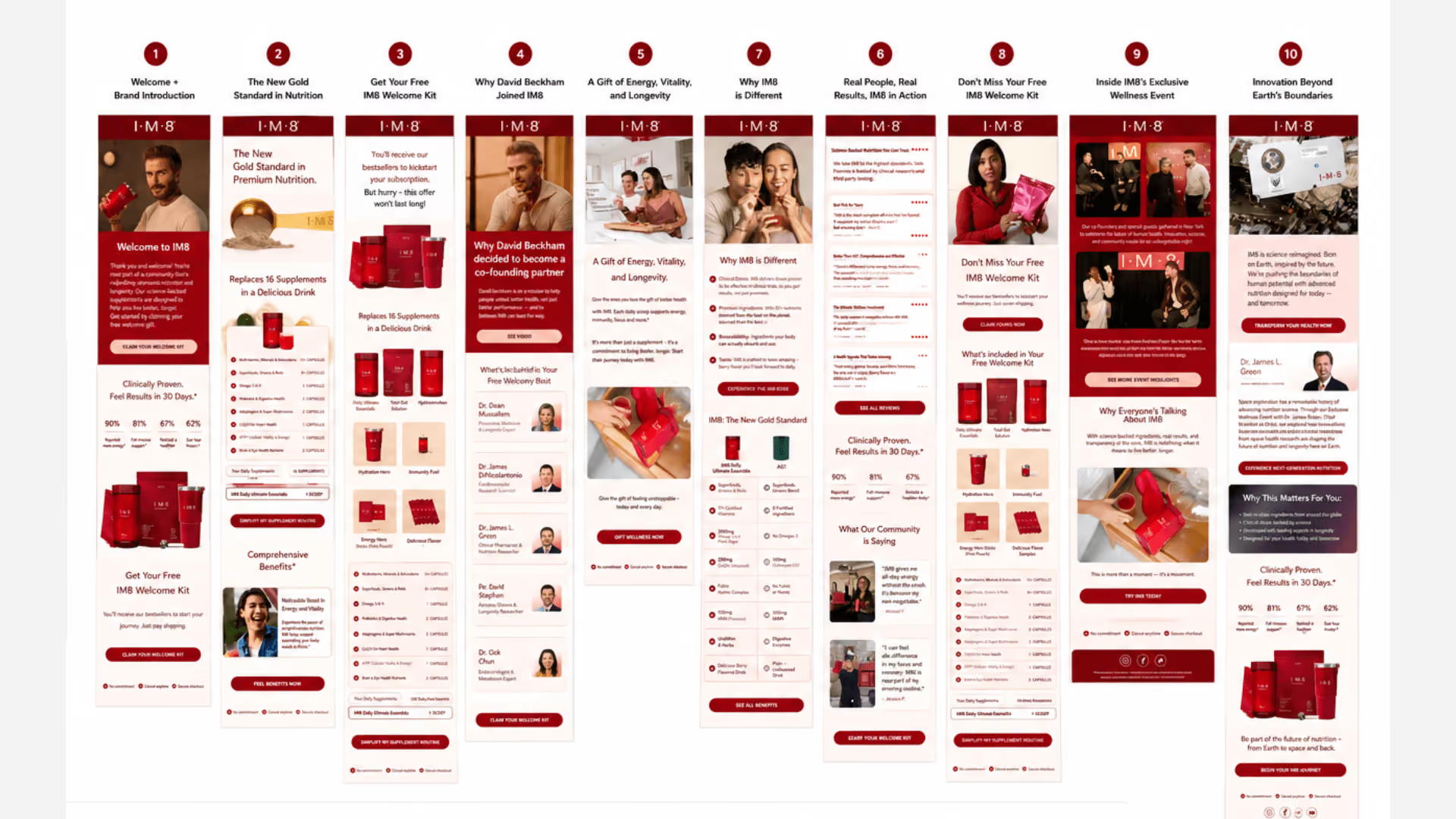
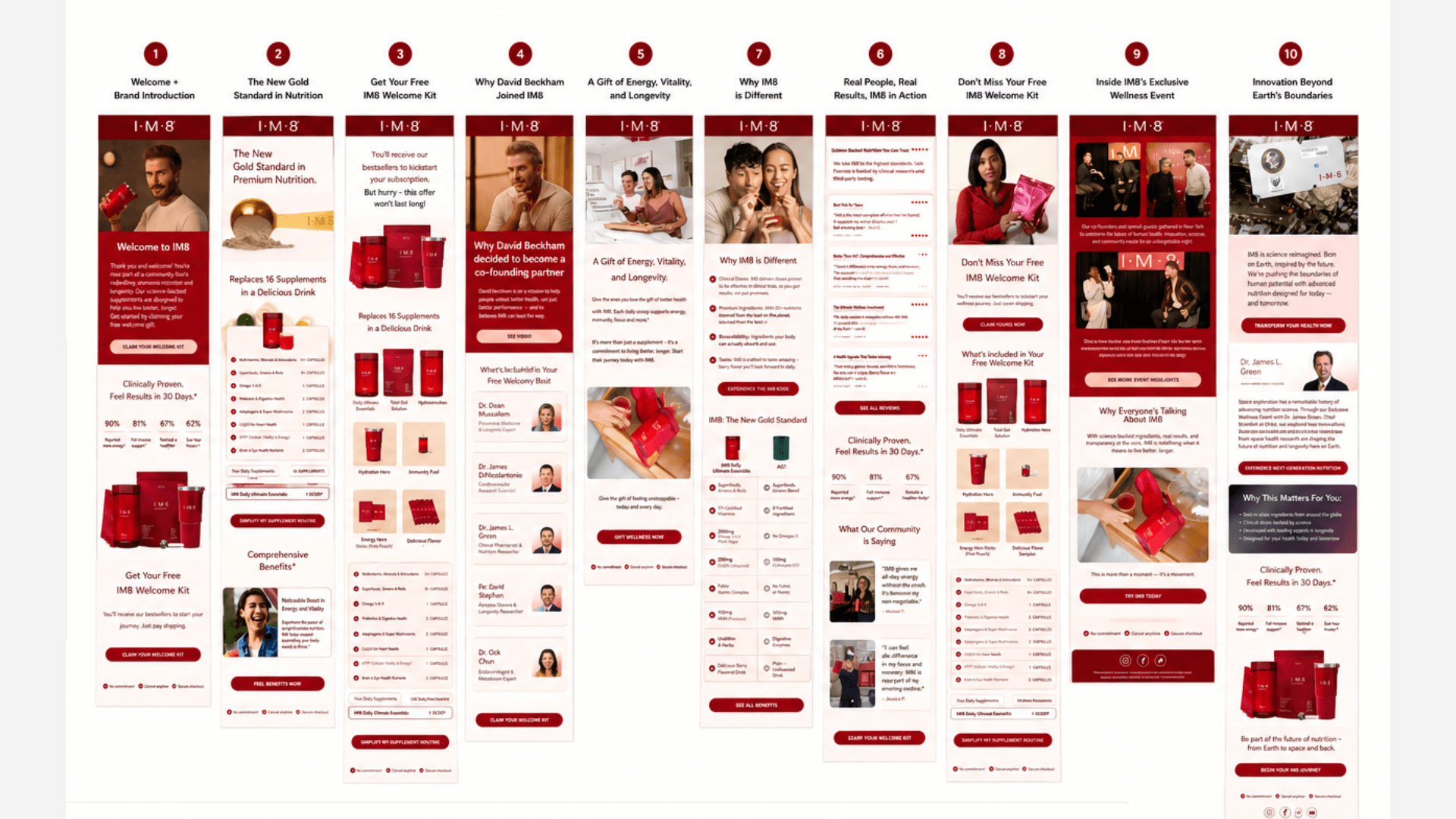
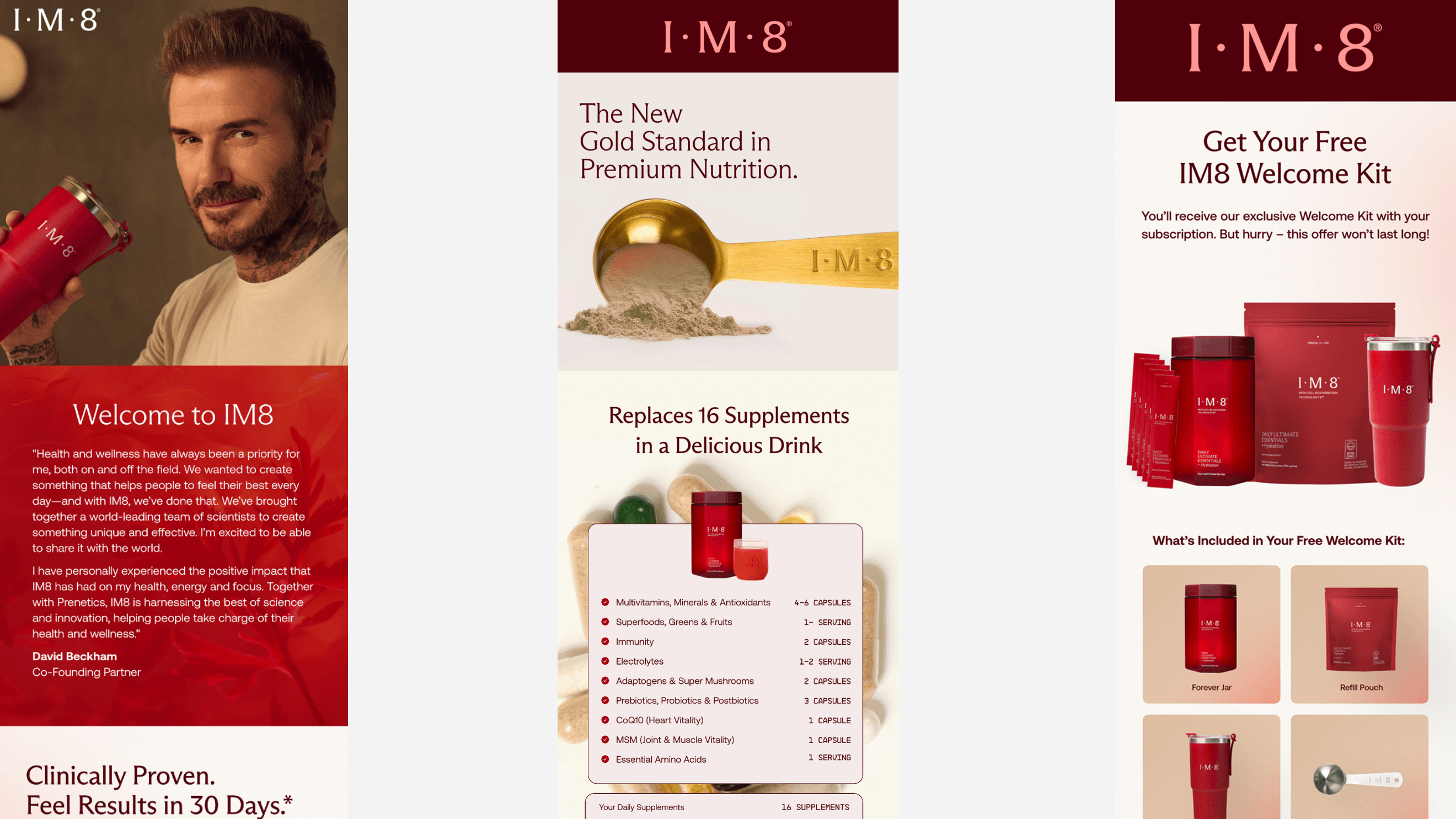
This infographic summarizes the structure and strategy behind the flow. Selected screenshots from the actual email sequence are shown below.
What they do
IM8 uses a deep product education flow to help subscribers understand the science, ingredients, and philosophy behind its all-in-one daily supplement. Instead of leading with discounts or limited-time offers, the flow answers the questions potential customers are most likely to have before purchasing:
What is IM8? How is it different from other supplements? Why was it created? What ingredients are included? What results can customers expect?
The sequence introduces subscribers to the products through a combination of educational content, clinical research, expert advisors, customer testimonials, and founder-led storytelling. Throughout the flow, IM8 reinforces its positioning as a premium wellness product by highlighting scientific backing, ingredient quality, and real customer outcomes.
Why it works
Many health and wellness products require more consideration than a typical ecommerce purchase. Customers are often evaluating competing products, researching ingredients, and looking for evidence before making a decision.
IM8 addresses these concerns proactively. Instead of asking subscribers to blindly trust the brand immediately, the flow systematically builds credibility through expert endorsements, scientific explanations, customer stories, and transparent product information.
Each email adds another layer of confidence that helps subscribers move closer to a purchase decision.
Key takeaway
When products require education, a discount alone is usually not enough to close the sale. That’s why the most effective product education flows help subscribers understand not only what the product is, but why it matters and why it's worth choosing over alternatives.
By proactively answering objections and reinforcing credibility throughout the sequence, brands can increase conversion rates while creating more informed customers.
What marketers can learn
If you're building a Klaviyo product education flow, consider including emails that cover:
The goal isn't simply to sell the product; it's to help subscribers become confident enough to buy. For products with longer consideration cycles, education is almost always the most effective form of persuasion.
3. Hims: Educational nurture email flow example
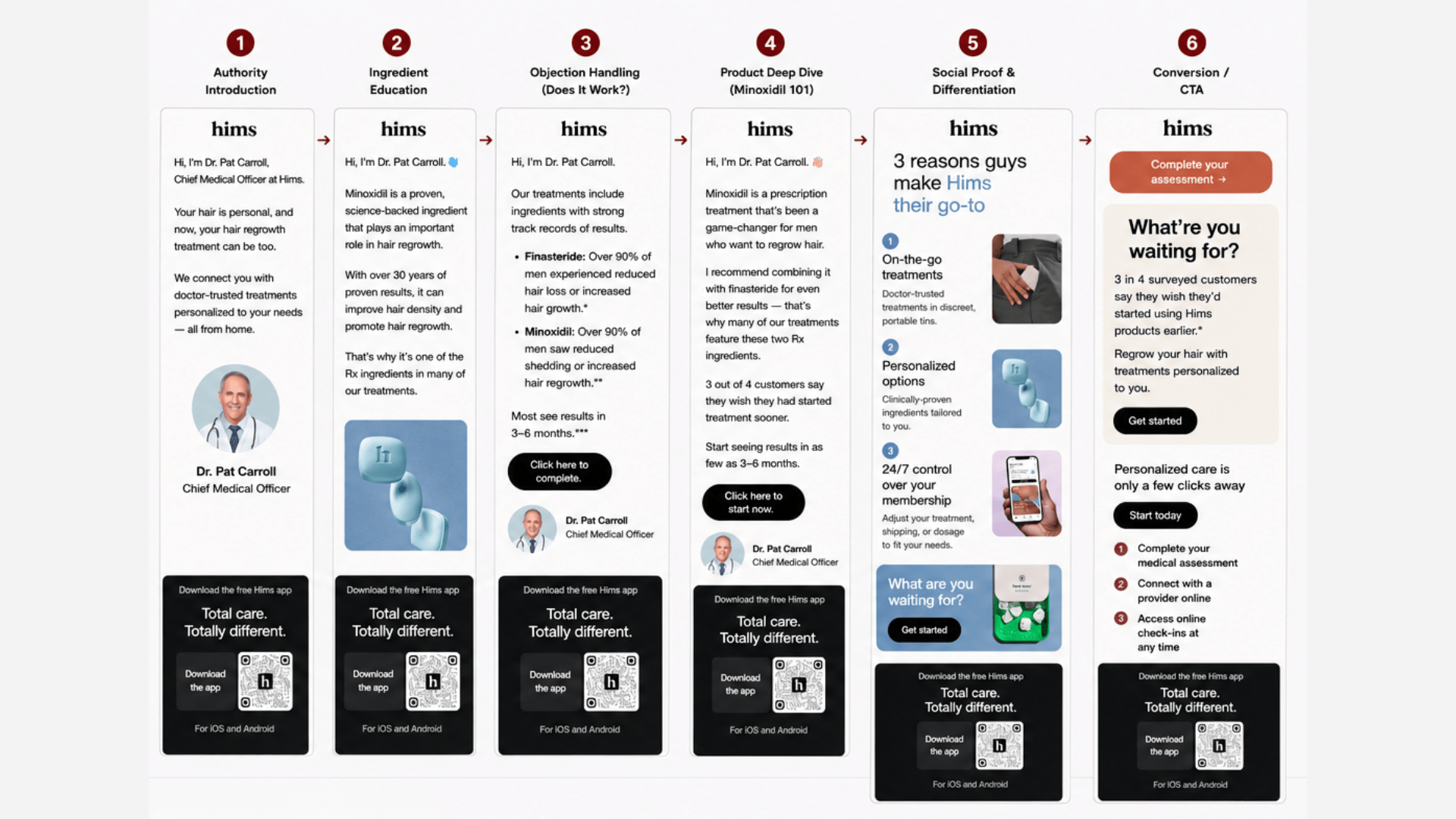
Hims uses a multi-step email nurture flow to build trust, educate prospects about hair loss treatments, address common objections, and encourage subscribers to complete their online assessment. The sequence combines physician-led education, clinical evidence, product differentiation, customer outcomes, and clear calls to action.
Flow type: Educational nurture flow
Goal: Build trust, answer objections, and move subscribers toward completing an assessment and starting treatment.
Where these emails appear: Automatically after a subscriber joins Hims' email list.
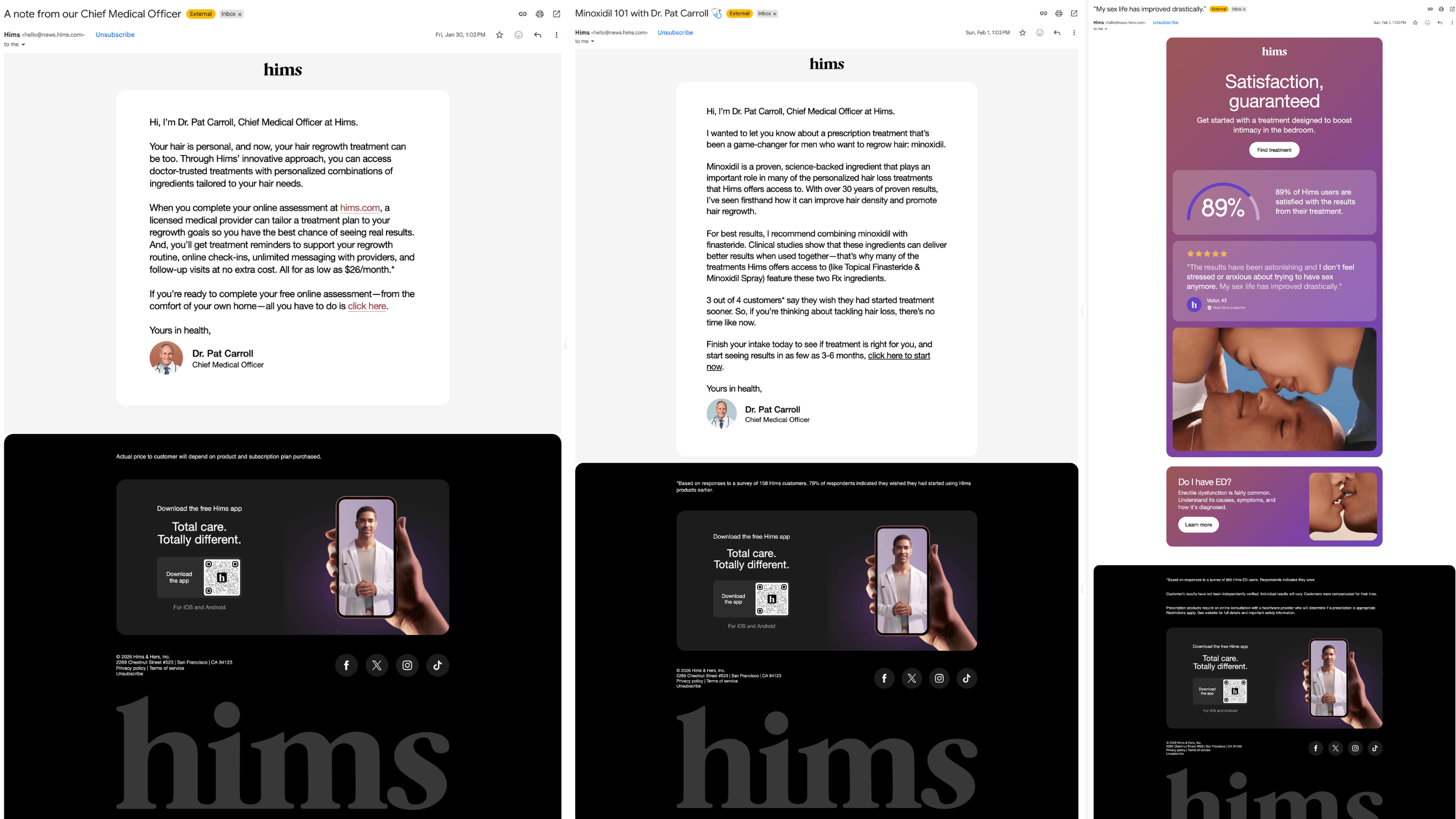
This infographic summarizes the structure and strategy behind the flow. Selected screenshots from the actual email sequence are shown below.
What they do
Hims uses a physician-led nurture sequence that gradually reduces uncertainty around hair loss treatment. Subscribers learn how treatments work, review clinical evidence, understand the benefits of Hims' approach, see customer outcomes, and get multiple opportunities to complete an assessment.
The sequence begins with several emails from Dr. Pat Carroll, Hims' Chief Medical Officer, who explains treatment options, discusses key ingredients like minoxidil, and addresses common questions about effectiveness. Later emails introduce customer success stories, highlight product benefits, and encourage subscribers to take the next step.
Why it works
Hair loss treatments require trust and education. Hims removes uncertainty by answering key questions, sharing clinical proof, and showcasing why thousands of men choose their products.
Instead of relying on a single sales email, the brand builds confidence over multiple touchpoints. Each email reinforces credibility, making it easier for subscribers to move forward with treatment.
Key takeaway
Educational nurture flows work best when they combine authority, evidence, and repetition. Hims doesn't rely on a single conversion email. Instead, it repeatedly reinforces trust through physician guidance, clinical proof, customer outcomes, and low-friction calls to action.
What marketers can learn
✓ Lead with authority & expertise ✓ Reintroduce trusted experts throughout the flow, not just once ✓ Educate on ingredients and how the treatment works ✓ Address objections with data & clinical proof ✓ Differentiate your brand & highlight key benefits ✓ Use social proof & customer outcomes to build credibility ✓ End with a clear, low-friction call to action
The goal is not just to generate clicks; it's to build enough confidence that taking the next step feels like the logical decision. For high-consideration products, educational nurture flows can be one of the most effective conversion assets in your Klaviyo account.
4. The Farmer's Dog: Category creation email flow example
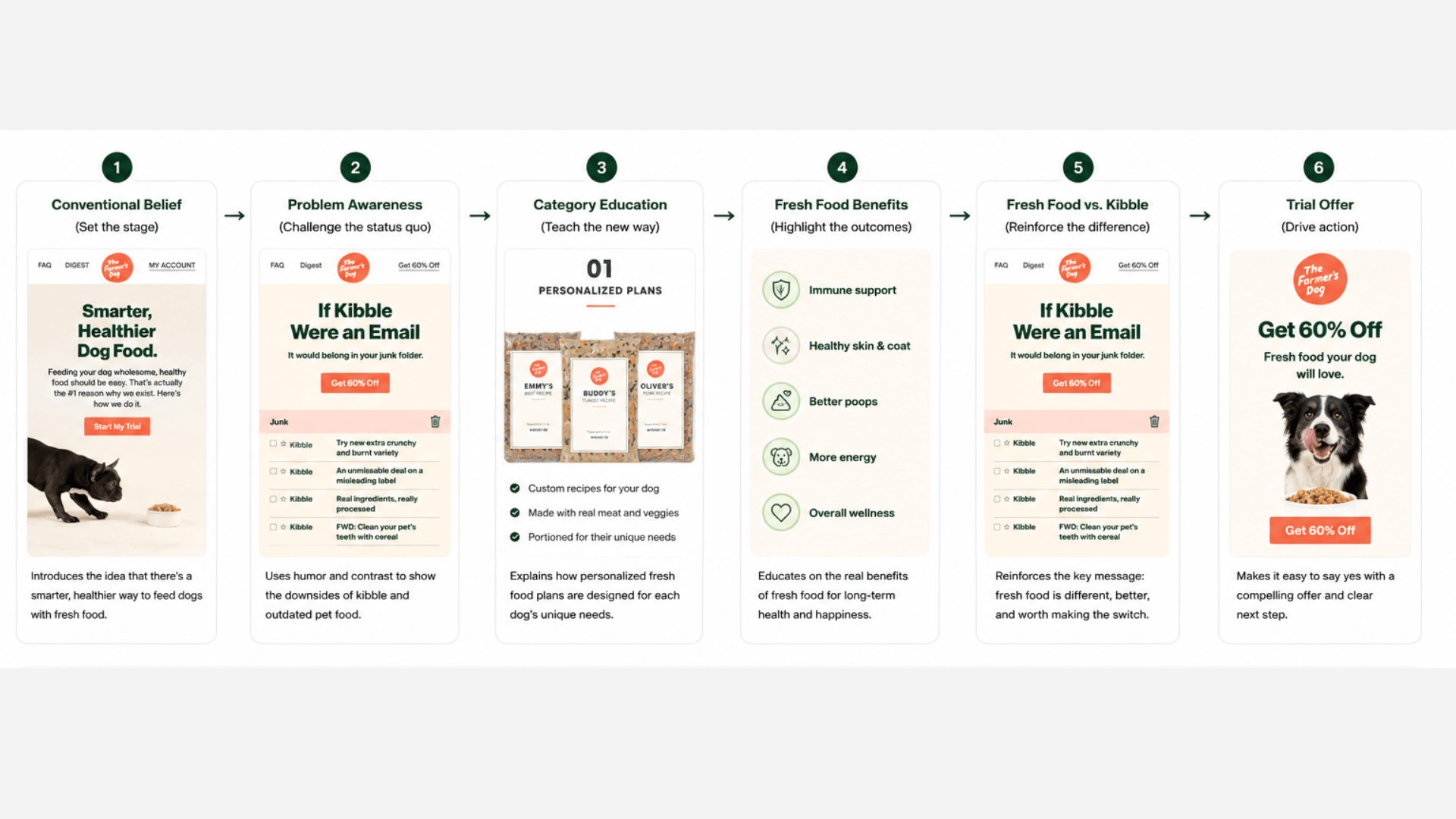
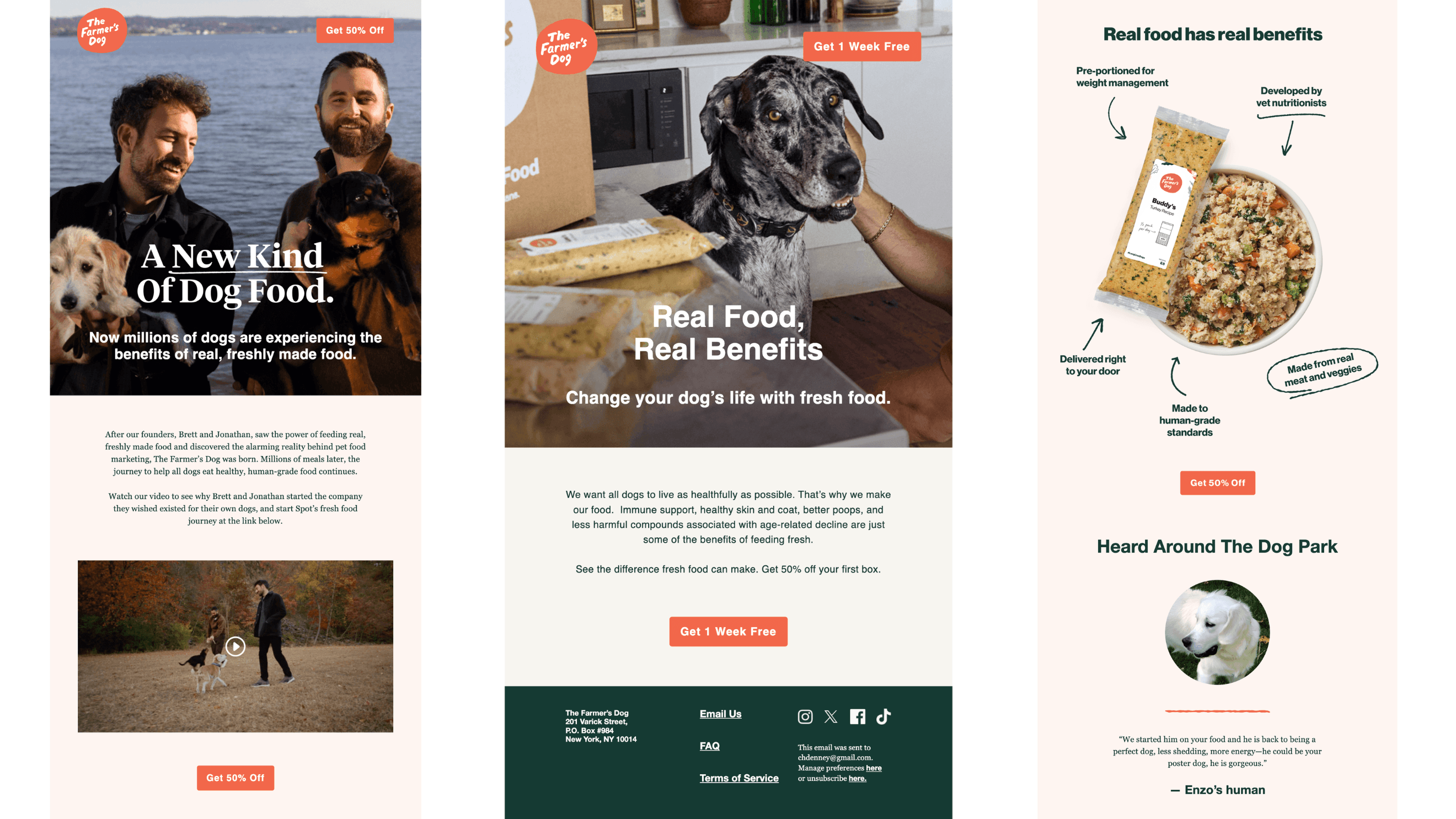
Farmer's Dog uses a category-creation flow to challenge conventional beliefs about dog food, teach the benefits of fresh food, and encourage subscribers to start a trial. Instead of just focusing on product features, the sequence helps prospects rethink what healthy dog nutrition should look like and positions fresh food as a better alternative to traditional kibble.
Flow type: Category creation flow
Goal: Educate prospects about fresh dog food, differentiate it from kibble, and drive trial purchases.
Where these emails appear: Early in the subscriber lifecycle, after someone joins The Farmer's Dog email list.
This infographic summarizes the structure and strategy behind the flow. Selected screenshots from the actual email sequence are shown below.
What they do
The sequence introduces subscribers to the concept of fresh dog food while challenging assumptions about traditional pet food. For example, one email positions fresh food as a smarter, healthier way to feed dogs and introduces personalized meal plans. Another compares kibble to junk email, using humor and contrast to highlight perceived shortcomings of conventional dog food.
Instead of immediately focusing on product features, the flow reshapes how subscribers think about the category itself. Once that new perspective is established, Farmer's Dog reinforces the benefits of fresh food and makes a compelling offer to drive new trials.
Why it works
Many dog owners have fed kibble for years and may not actively question it. The Farmer's Dog understands that before someone adopts a new solution, they often need to see the existing solution differently.
The flow uses education, contrast, and memorable messaging to make traditional pet food seem outdated while positioning fresh food as the better alternative. By changing how prospects evaluate dog food, the brand creates demand before asking for a purchase.
Key takeaway
Some of the most effective flows don't just sell a product. They change how prospects think about an entire category.
Farmer's Dog reframes the conversation around fresh food versus kibble, creating a new buying framework before presenting its offer. By the time subscribers see a trial promotion, they already know why the product exists and how it differs from traditional pet food alternatives.
What marketers can learn
→ Challenge assumptions about the status quo → Educate prospects before selling → Use category comparisons to create contrast → Make complex ideas memorable through creative analogies → Position your product as a better alternative, not just another option → Use nurture flows to reshape buying criteria → Create demand before driving conversion
5. Sundays: Post-purchase onboarding email flow example
Flow type: Post-purchase onboarding flow
Goal: Help customers successfully start using the product, reduce support requests, and improve retention.
Where these emails appear: Immediately after a customer places their first order.
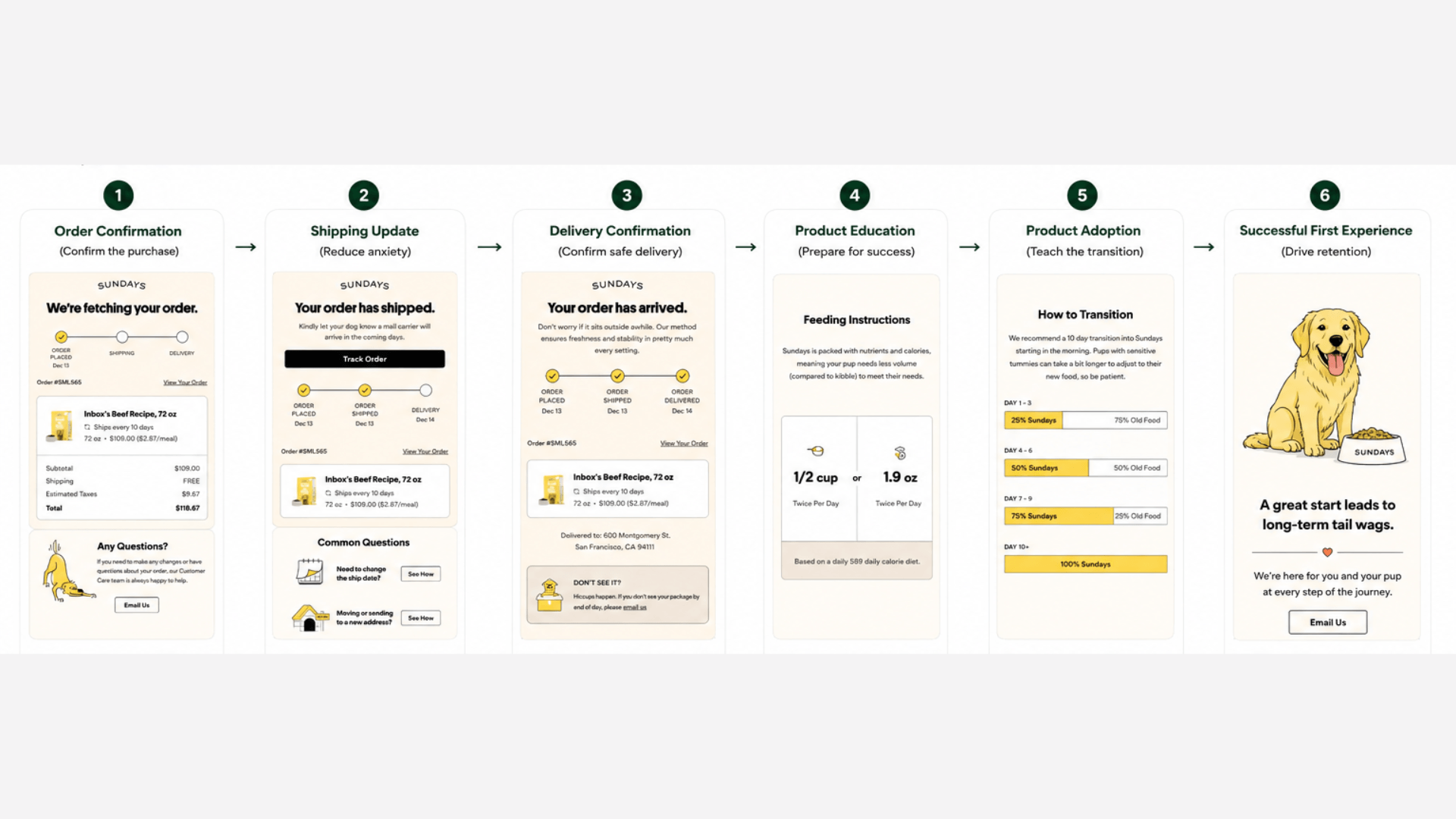
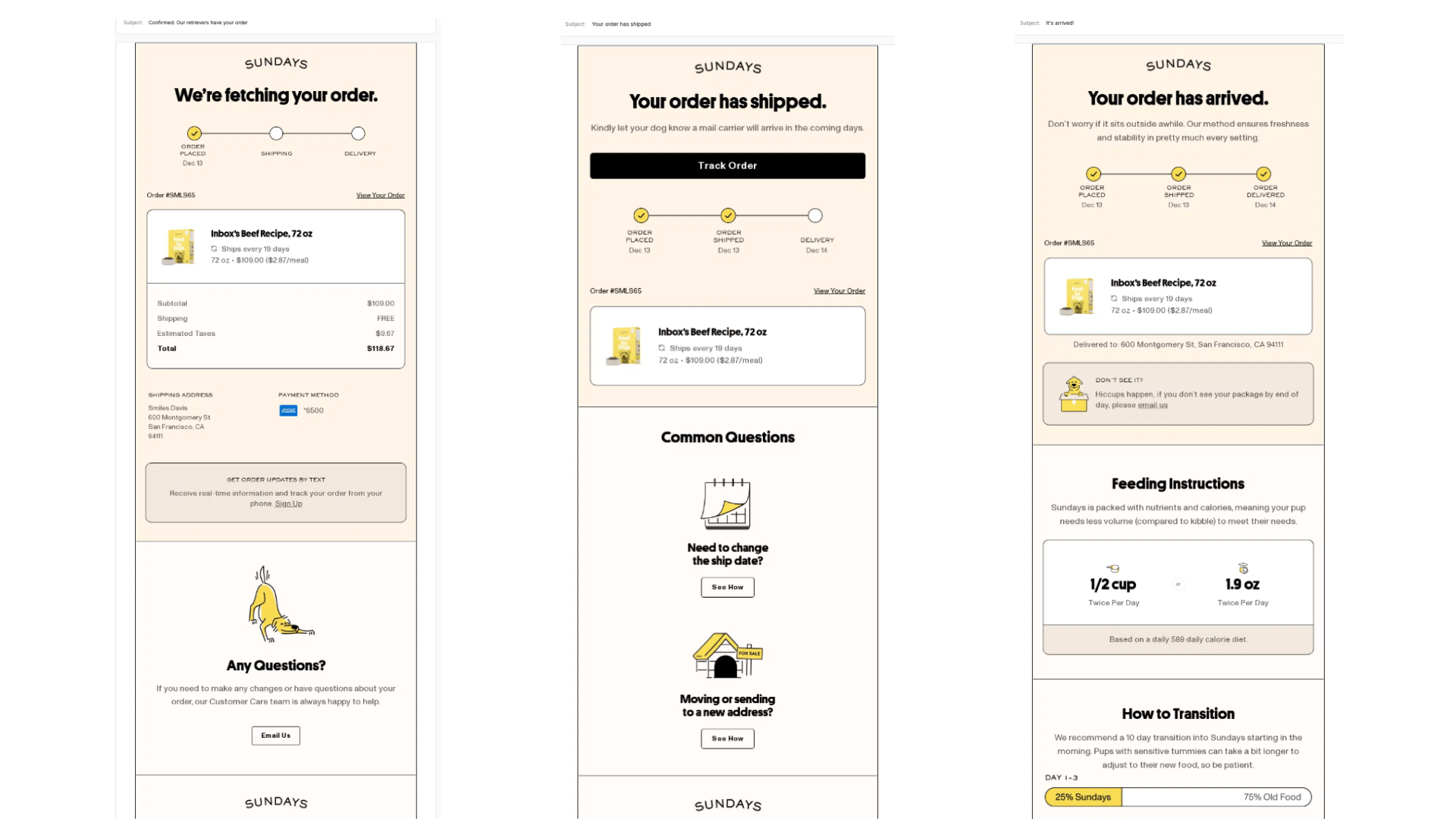
This infographic summarizes the structure and strategy behind the flow. Selected screenshots from the actual email sequence are shown below.
What they do
Sundays uses a post-purchase onboarding flow to guide customers from purchase through successful product adoption. The sequence begins with order confirmation and shipping updates before transitioning into educational content that helps dog owners use the product correctly.
Instead of ending communication after the sale, Sundays continues supporting customers throughout the onboarding process. Subscribers receive delivery notifications, feeding recommendations, transition instructions, and answers to common questions.
Why it works
Many ecommerce brands focus heavily on acquiring customers but don’t invest much in the first experience after purchase. Sundays recognizes that long-term retention greatly depends on what happens after the order is placed.
By proactively answering questions and helping customers use the product correctly, the brand reduces confusion, improves customer satisfaction, and increases the likelihood of repeat purchases.
Key takeaway
The best onboarding flows don't simply provide transactional updates. They help customers achieve the outcome they purchased the product for. Sundays combines order updates, customer education, and product adoption guidance to create a smoother first experience and increase retention.
What marketers can learn
→ Continue nurturing customers after the sale → Use transactional emails as engagement opportunities → Anticipate and answer common questions proactively → Help customers achieve success quickly → Reduce support tickets through education → Improve retention through better onboarding → Focus on product adoption, not just conversion
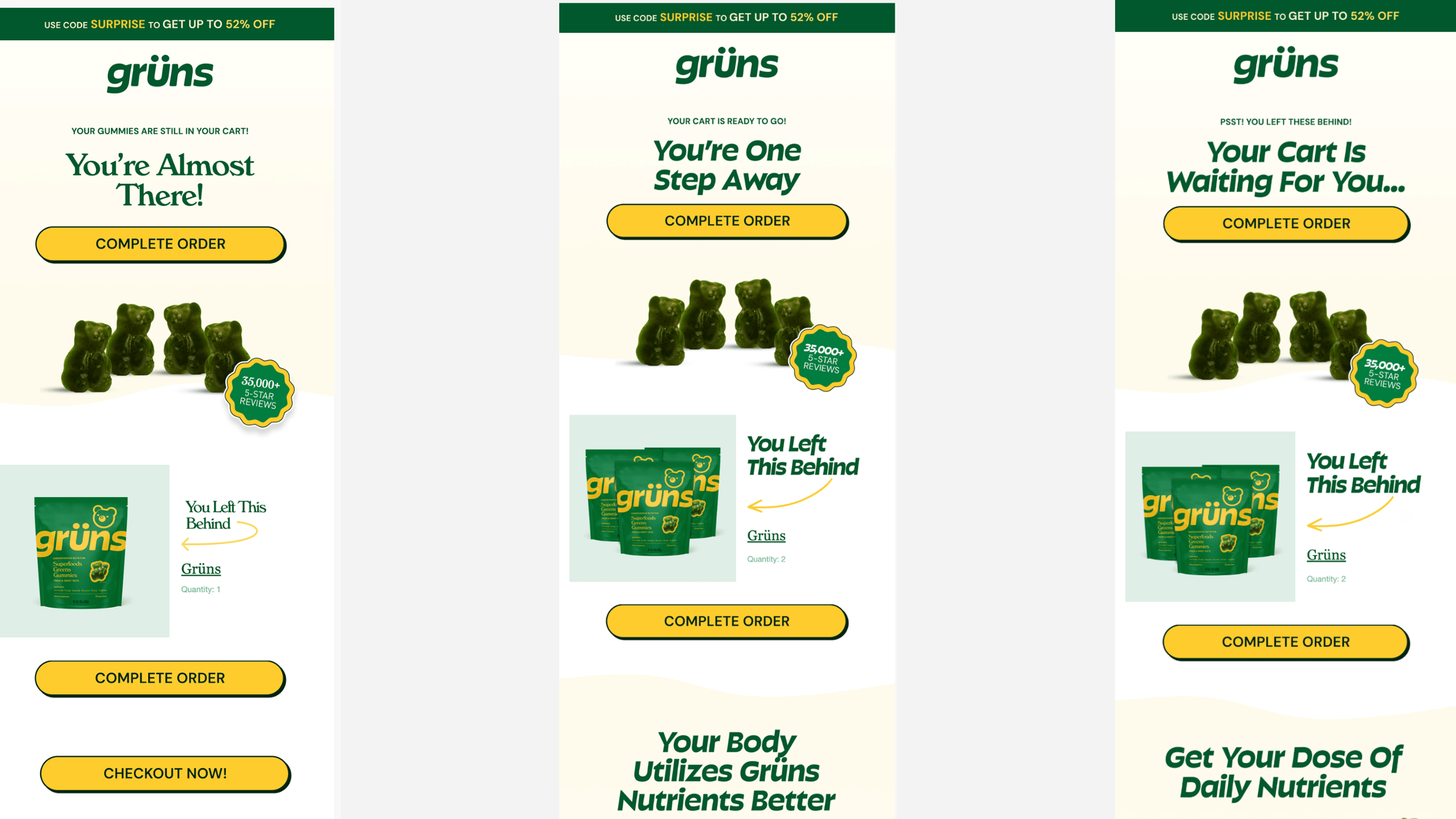
6. Grüns: Abandoned cart recovery email flow example
Flow type: Abandoned cart recovery flow
Goal: Recover abandoned carts, address buying objections, and convert hesitant shoppers into paying customers.
Where these emails appear: After a shopper adds products to their cart but leaves without completing their purchase.
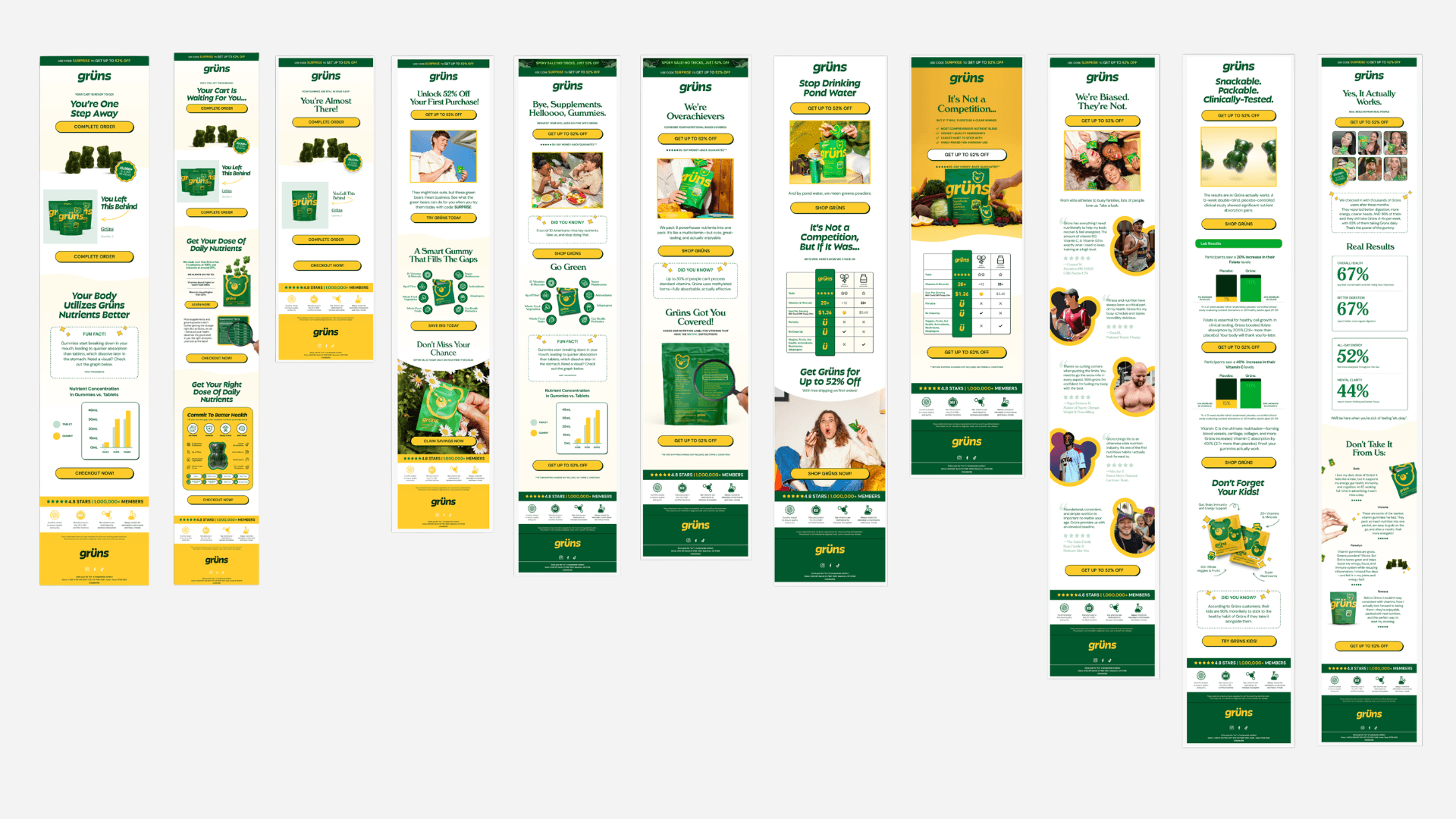
This infographic summarizes the structure and strategy behind the flow. Selected screenshots from the actual email sequence are shown below.
What they do
Grüns uses an abandoned cart flow that does more than remind shoppers to return and complete their purchase. The sequence begins with traditional cart reminders before gradually introducing education, product differentiation, social proof, and incentives.
Instead of repeatedly sending the same message, each email focuses on a different buying trigger. Shoppers learn how Grüns differs from traditional supplements, see nutritional comparisons, read customer success stories, and see additional proof that the product delivers results. By the end of the sequence, the flow has answered many of the questions and overcome objections that commonly prevent a first purchase.
Why it works
Many abandoned cart flows assume shoppers simply got distracted; Grüns recognizes that hesitation often comes from uncertainty. Customers may be evaluating alternatives, questioning the product's value, or wondering whether the results justify the investment.
By combining reminders with education and proof, the brand continues building conviction after the shopper leaves the site. Each email provides another reason to buy, creating multiple opportunities to move prospects closer to a purchase decision.
Key takeaway
The best abandoned cart flows don't rely exclusively on reminders and discounts. Grüns treats cart abandonment as an opportunity to continue the sales conversation. By combining education, product differentiation, customer proof, and strategic offers, they turn a simple recovery sequence into a complete conversion funnel.
What marketers can learn
→ Go beyond basic cart reminders → Introduce new information throughout the sequence → Use education to address common objections → Highlight product differentiation repeatedly → Leverage customer stories and social proof → Use incentives strategically instead of immediately → Treat abandoned cart flows as sales sequences, not recovery campaigns
7. Patagonia: Product recommendation email flow example
Flow type: Product recommendation flow
Goal: Increase product discovery, re-engage interested shoppers, and drive repeat purchases through relevant recommendations.
Where these emails appear: After browsing activity, product interest, category engagement, or previous purchases.
What they do
Patagonia uses a product recommendation flow to help shoppers discover relevant products, re-engage high-intent buyers, and increase repeat purchases through personalized recommendations.
The sequence begins with broad product discovery emails like “Find a New Favorite,” which introduce shoppers to products they may not have considered. From there, Patagonia narrows recommendations around specific use cases with emails like “Your Travel GOATs,” helping shoppers find products suited to how they actually plan to use them.
They also use behavioral triggers such as “Back in Stock” emails to re-engage shoppers who previously showed interest in a product, while emails like “Pile It On” introduce complementary products that drive larger purchases and deeper product adoption.
Why it works
Many ecommerce brands treat product recommendations as little more than automated product grids. Patagonia takes a more thoughtful approach by connecting recommendations to customer intent.
Instead of simply showing more products, they organize recommendations around activities, interests, and real-world use cases. This makes their emails feel more helpful and relevant while creating natural opportunities for additional purchases.
The back-in-stock email is particularly powerful because it targets shoppers who’ve already demonstrated interest in a specific product. Few recommendation emails reach a higher level of buying intent.
Key takeaway
The best product recommendation flows don't just promote products. They help shoppers discover products that fit what they're already trying to accomplish. Patagonia combines product discovery, use-case merchandising, behavioral triggers, and cross-sell recommendations to create a recommendation engine that feels helpful rather than promotional.
What marketers can learn
→ Use recommendations to support discovery, not just promotion → Organize products around customer interests and use cases → Trigger back-in-stock emails for high-intent shoppers → Use behavioral data to increase recommendation relevance → Cross-sell complementary products after engagement → Create recommendation paths that feel helpful, not sales-focused → Treat product recommendations as a retention channel, not just a conversion tactic
No items found.
Common mistakes in Klaviyo email flows
After reviewing dozens of high-performing ecommerce brands, one pattern becomes clear: Most brands don't have a flow problem. They have a messaging problem.
Many Klaviyo accounts contain the right “basic” automations:
Unfortunately, a lot of times the content in those flows isn't strong enough to drive meaningful results. Here are some of the most common mistakes.
Selling too early
Many brands ask for the order before creating understanding. The strongest examples in this article spend time educating, building trust, and answering questions before pushing for conversion.
Overusing discounts
While discounts can create urgency, they rarely create demand. Brands like IM8, Hims, and The Farmer's Dog demonstrate how education, positioning, and trust-building can outperform aggressive discounting.
Ignoring post-purchase marketing
The customer journey doesn't end after checkout. Sundays provides a strong example of how post-purchase onboarding can improve product adoption, reduce support requests, and increase retention long after the initial sale.
Sending generic messages
Personalized emails consistently outperform generic broadcasts. Patagonia and The Farmer's Dog show how relevance often outperforms volume. Whether it's personalized meal recommendations or product suggestions based on customer interests, the most effective flows feel tailored to the individual receiving them.
Essential Klaviyo email flows every ecommerce brand should have
If you're building a Klaviyo account from scratch, start with these flows.
1. Welcome flow
Introduces new subscribers to your brand and products.
2. Cart abandonment flow
Recovers shoppers who started checkout but didn't complete their purchase.
3. Browse abandonment flow
Re-engages visitors who viewed products without adding them to their cart.
4. Post-purchase flow
Reinforces the purchase decision and helps customers succeed.
5. Review request flow
Collects customer reviews and social proof.
6. Winback flow
Re-engages customers who haven't purchased recently.
7. Product recommendation flow
Drive more repeat purchases by recommending products shoppers are most likely to buy next. The best email programs aren't built all at once; they're built incrementally over time.
Once those foundational flows are built out, you can expand into:
Klaviyo determines what happens after someone joins your email list. ConvertFlow helps determine who joins your email list—and what you know about them before they enter your flows.
By collecting zero-party data through quizzes, landing pages, and popups, brands can trigger more relevant Klaviyo flows, personalize messaging, and improve lifecycle performance.
For example:
→ Hims uses educational content because different subscribers have different concerns.
→ The Farmer's Dog personalizes emails based on customer information.
→ IM8 benefits from understanding customer interests before sending follow-up emails.
→ Grüns can tailor messaging based on visitor intent.
→ Patagonia makes better recommendations when shopper interests are collected before the email sequence begins.
Thousands of fast-growing brands use ConvertFlow quiz funnels, landing pages, and popups to collect zero-party data before a subscriber enters a Klaviyo flow. That data can then be used to:
✓ Trigger more relevant flows
✓ Improve personalization
✓ Increase conversion rates
✓ Create more targeted campaigns
The result is a more relevant, tailored customer experience and better-performing lifecycle marketing.
What the best Klaviyo email flows have in common
The best Klaviyo flow examples aren't necessarily the most sophisticated; they're the most targeted and personalized.
Whether it's a welcome flow from HexClad, a product education flow from IM8, a nurture flow from Hims, a category creation flow from The Farmer's Dog, an onboarding flow from Sundays, an abandoned cart flow from Grüns, or a recommendation flow from Patagonia, the pattern is remarkably consistent…
Each flow has a clear purpose. The strongest ecommerce brands don't build automations just because Klaviyo makes them available; they build flows that solve specific customer problems at specific stages of the buying journey.
Some flows build trust, some answer objections, some recover lost sales, some help customers succeed after purchase, and others increase retention and repeat purchases. Study these flows, borrow the ideas, and adapt them to your own business.
The best Klaviyo accounts aren't built by adding more automations; they're built by improving the messages inside them.
Jonathan Denney leads product at ConvertFlow. After running a marketing agency with his brother Ethan Denney, Jonathan & Ethan co-founded ConvertFlow to help brands build funnels without code or waiting on developers. Since then, ConvertFlow's funnel builder has helped launch 200k+ funnels across brands such as Porsche, HausLabs by Lady Gaga, CampingWorld and more.
Explore more examples
Get more inspiration with our library of funnel examples and marketing campaigns






.svg)
