

How to Fix Ecommerce Quiz Funnel Drop Off in 2026
Your ecommerce quiz funnel is bleeding shoppers at every step, and you probably can't see exactly where. You built the quiz to guide visitors toward the right products, but somewhere between "Start Quiz" and "Add to Cart," people quietly disappear. After helping ecommerce brands build and optimize thousands of these funnels, we've learned the leaks are predictable—and fixable.
We work on ecommerce quiz funnels every day at ConvertFlow, and the same leaks show up again and again. This guide breaks down where quiz funnels actually lose shoppers, what causes each drop-off, and the specific fixes we reach for first. You'll walk away with a clear action plan for lifting your own quiz completion rates and turning more quiz takers into buyers.
Key Takeaways: How to Fix Ecommerce Quiz Funnel Drop Off in 2026
- Quiz funnels have multiple independent drop-off points, so measuring a single conversion rate hides where you're actually losing shoppers and revenue.
- The email capture gate creates the steepest cliff in most quiz funnels, often causing 30-50% of finishers to abandon before seeing results.
- Quizzes with 6-12 questions outperform shorter ones because they build enough trust for shoppers to believe the recommendation is personalized.
- ConvertFlow helps ecommerce brands identify step-level drop-off patterns and run A/B tests on individual quiz elements without breaking attribution.
- A 10-percentage-point improvement in completion rate can mean 15 additional conversions per month from the same traffic volume.
What Is Quiz Funnel Drop-Off and Why Does It Matter?
Quiz funnel drop-off happens when shoppers start your product recommendation quiz but leave before completing it or making a purchase. Unlike a standard product page where you have one conversion point, quiz funnels have multiple steps where visitors can exit.
Each step is its own decision point. A shopper who clicks "Start Quiz" has already shown interest, but they re-decide whether to continue at every single question. The drop-off compounds fast: a six-step quiz with 70% step-completion still delivers only 12% of starters to the recommendation page.
Here's what most brands miss when they look at one blended conversion number: quiz abandoners aren't random visitors. They've demonstrated purchase intent by engaging with your quiz in the first place. Win back even a fraction of them and the revenue lands straight on your bottom line.

Where Do Ecommerce Quiz Funnels Actually Leak?
Drop-off follows predictable patterns. Once you know where they are, you know exactly where to spend your optimization time.
The First Question Drop-Off
The highest abandonment often occurs at step one. This isn't because shoppers changed their minds about wanting results. It's because the entry screen fails to reduce uncertainty fast enough.
Visitors face immediate questions: How long will this take? What format is expected? What does this first step have to do with the result I was promised? When the screen design doesn't answer these questions, shoppers stall and then leave.
The Mid-Funnel Ambiguity Zone
The second major drop-off cluster appears around the 40-60% completion mark. Shoppers who've invested time hit a point where the result still feels distant, cognitive load has built up, and they start questioning whether finishing is worth the effort.
Without clear progress signals, the question "should I keep going?" becomes louder than the desire to see results.
The Email Gate Cliff
The email capture screen before the results page creates the steepest single cliff in most quiz funnels. In the funnels we see, 30-50% of finishers drop at this one step. They've answered every question, then balk at paying with their email for something that still feels abstract.
The Recommendation Page Failure
Even shoppers who reach your results page can bounce if the recommendation doesn't feel personalized or the call-to-action doesn't guide them toward purchase. Many brands design recommendation pages that look like quiz-result screens rather than conversion pages.
How to Diagnose Your Quiz Funnel Problems
Before you change anything, get step-level data. Tracking only "quiz starts to purchase" masks where your real problem is. A 3% conversion rate could mean a brilliant recommendation page rescuing a leaky question sequence, or a strong sequence wasted by a weak results page. The fixes for those two are completely different.
Set Up Step-Level Tracking
Whenever we audit a quiz funnel, step-level data is the first thing we pull. Most quiz apps expose step-level events you can connect to your analytics; if yours doesn't, instrument it manually. Without per-step completion data, every optimization is a guess.
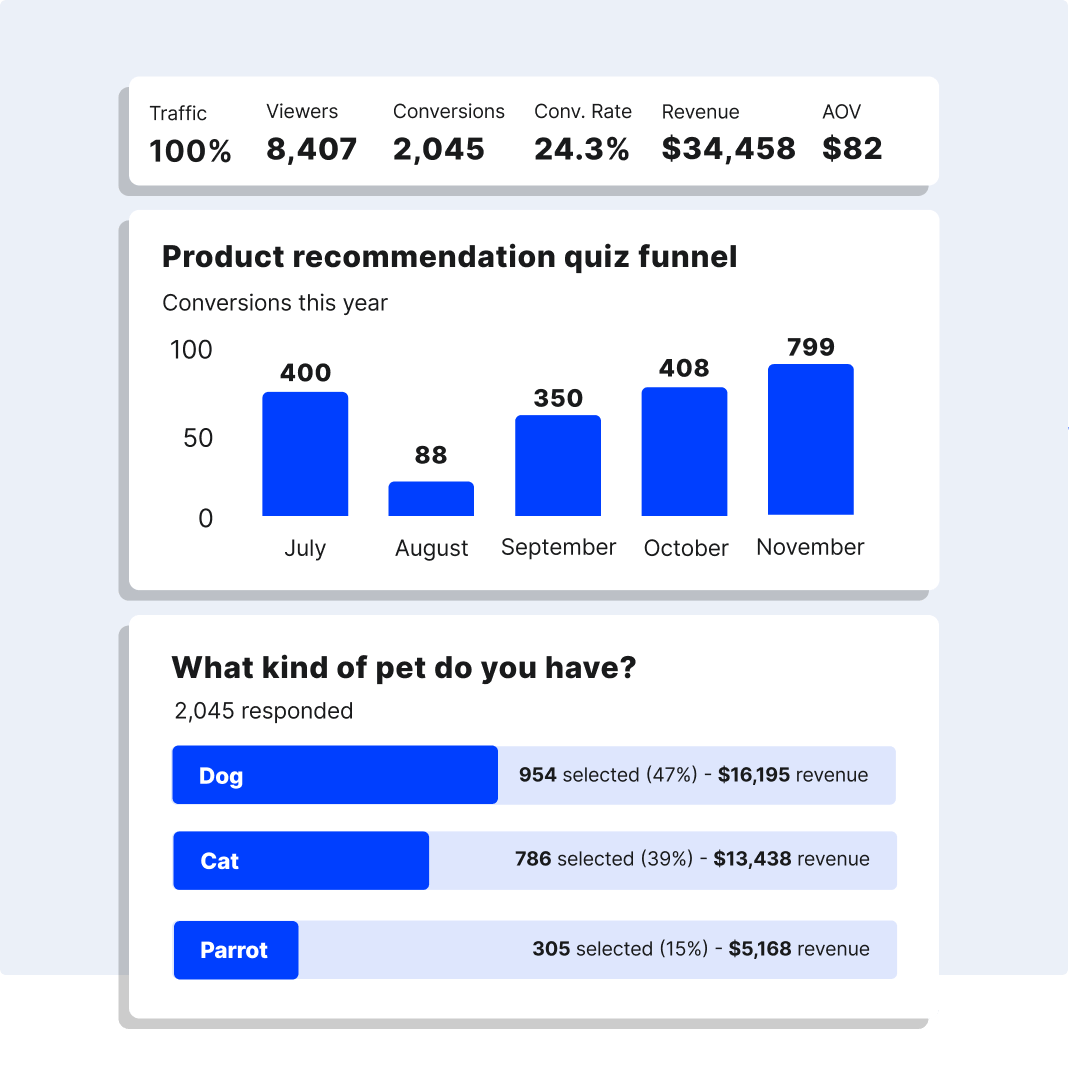
ConvertFlow's funnel conversion reports show you exactly how many people progressed from one step to the next, revealing where shoppers drop and where your funnel holds strong.
Watch Session Recordings
Heatmaps on single-question steps mostly tell you that people clicked answers, which you already knew. Session recordings are where the insight is: you see hesitation, scroll-backs, and the exact moments shoppers give up mid-quiz. Watch ten abandon sessions before you design a single test.
Rank Steps by Revenue Impact
Fix steps in revenue order, not funnel order. A step that loses 40% of 1,000 visitors costs you more than one that loses 60% of 200. Calculate the absolute drop-off contribution for each step and prioritize from there.
How to Fix First-Step Drop-Off
The first question sets expectations for every screen that follows. Get it wrong and uncertainty compounds through the entire flow.

Show Total Quiz Length Immediately
Display the total number of steps from the very first screen. "Question 1 of 5" reassures shoppers that the commitment is finite. Don't bury this in the UI; make it visible and prominent.
Connect the First Question to the Promised Result
Add a framing note beneath the first question that ties it to the outcome: "Your answer here shapes your personalized product recommendations." This reminds shoppers why they're investing their time.
Start with the Most Accessible Question
Lead with questions grounded in concrete, recent experience rather than abstract concepts. "What's your skin type?" works better as a first question than "What are your long-term skincare goals?" Save the complex questions for after momentum builds.
Add Quick-Start Options
For open text fields, provide clickable example answers that model the expected format without removing the option to personalize. This reduces friction for shoppers unsure what to write.
How to Fix Mid-Funnel Drop-Off
The ambiguity zone kills conversions because shoppers lose confidence that finishing is worth the effort. Combat it with progress mechanics and momentum signals.
Use a Persistent Progress Bar
Position a progress bar at the top of every screen. Show both position and context: "Step 3 of 5: Ranking your preferences" outperforms a bare progress percentage.
Reframe Progress Language
Shift from deficit framing to achievement framing. "3 strong answers captured, 2 more will complete your profile" motivates better than "3 of 5 questions answered."
Add Mid-Funnel Acknowledgment
At the halfway point, include a micro-reward. A single sentence acknowledging progress and renewing the value proposition keeps motivation high: "Halfway there. Your answers are already building a clear picture of your needs."
Smooth the Difficulty Curve
Sequence questions so cognitive demand peaks early when motivation is highest, then eases as the shopper nears completion. Front-loading the hard questions while momentum is strong keeps late-stage abandonment low.
How to Fix Email Gate Drop-Off
The email gate is necessary for many ecommerce strategies but deadly for conversion when handled poorly. The whole game is making the value exchange feel fair.
Preview the Result Before the Gate
Show shoppers what they're about to receive. "Based on your answers, your skin type is Combination. Enter your email to see your full skincare routine and personalized product recommendations." Concrete previews convert better than abstract promises.
Reframe the Gate as Delivery
"Where should we send your results?" converts better than "Enter your email to unlock your results." One feels like service; the other feels like a toll.
Be Specific About What They'll Receive
"Your personalized report includes your top three recommended products, why each one fits your needs, and a discount code for your first order." Vague descriptions produce vague motivation to complete.
Consider Gate Position
Placing the email gate before results captures more emails but loses 30-50% of finishers. Placing it after results captures fewer emails but converts more shoppers to cart. Choose based on whether list growth or immediate revenue is the priority right now.
How to Fix Recommendation Page Drop-Off
Your recommendation page has to do the selling work a category page would normally do. Too many brands treat it as a quiz result screen instead of a conversion page, and it shows in the numbers.
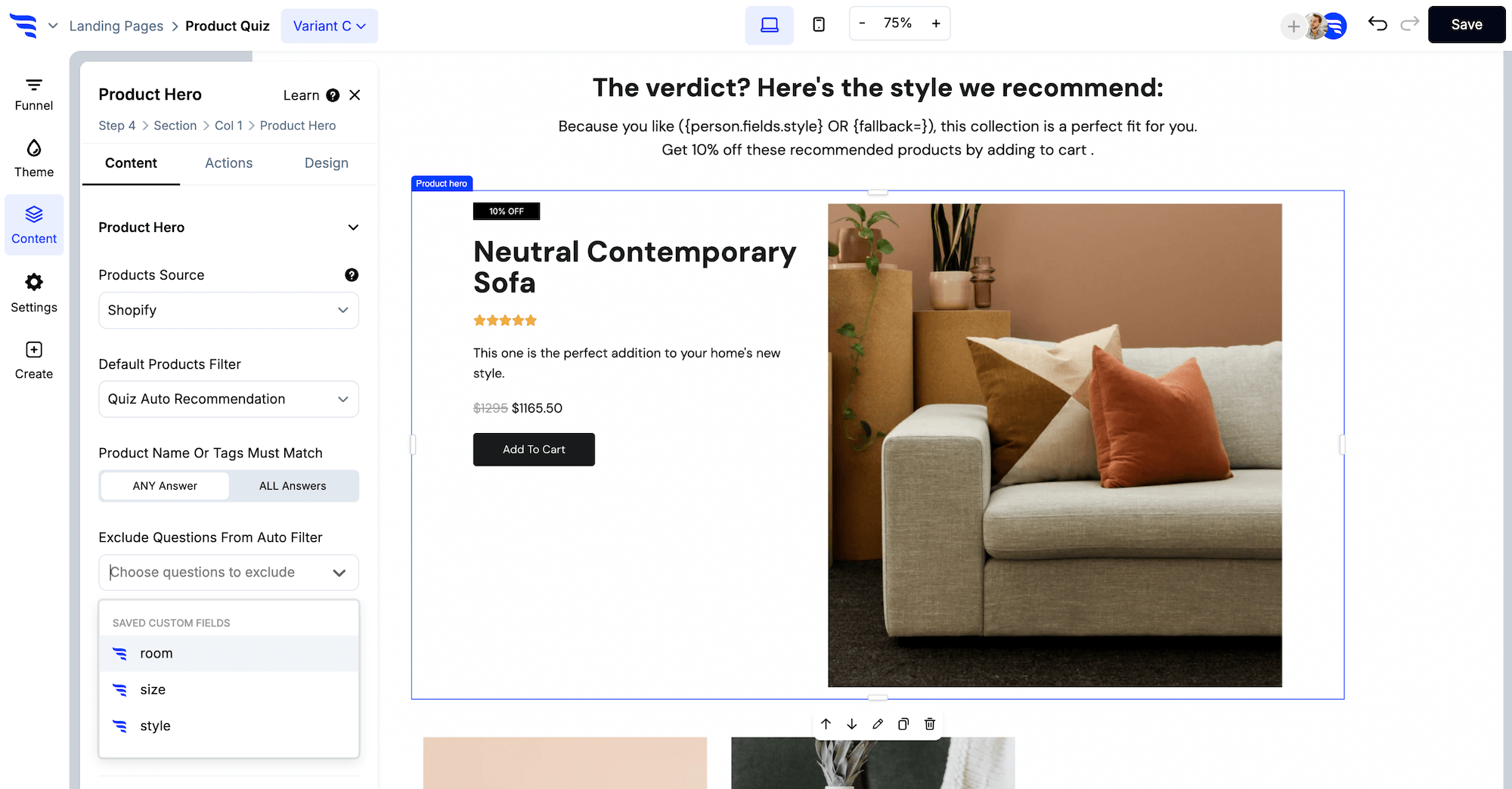
Treat It Like a Product Page
Include product images, benefit-focused descriptions, social proof, and clear calls-to-action. The shopper has qualified themselves through the quiz; now close the sale.
Limit Product Recommendations
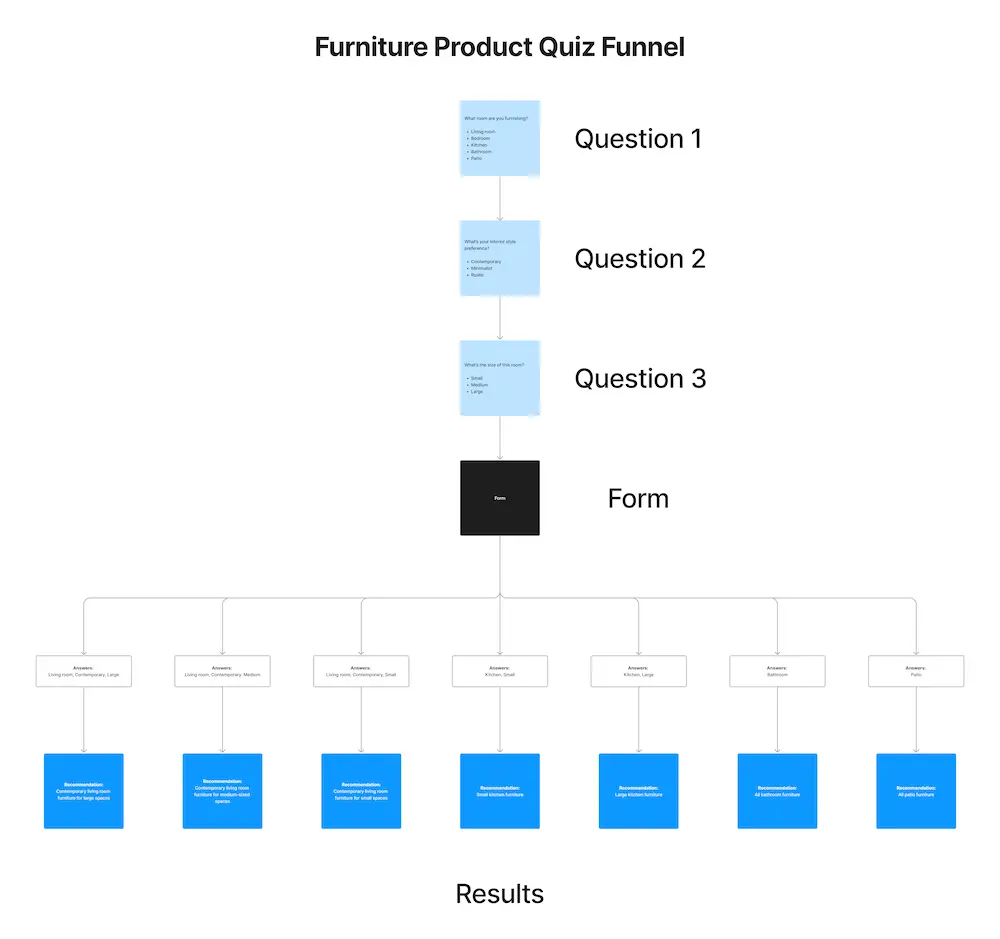
Our platform data is blunt on this one: quizzes that land shoppers on a single results page with 1-3 product recommendations convert at 10.6% on average, while those spreading shoppers across 11+ results pages fall to 7.1%. That 3.5-point gap is real revenue. Collapse your results-page mapping until every customer lands on one page with confident recommendations.
Show Confidence in Your Recommendations
"Based on your answers, this is exactly what your skin needs" converts better than hedging like "you might also like." The quiz already did the work; don't undercut it with uncertain copy.
Use Action-Oriented CTAs
"Add to Cart," "Get Your Routine," or "Claim My Discount" outperform generic buttons like "Continue" or "Submit." Once the recommendation lands, button text is your most direct conversion lever.
Quiz Length: The Truth About Question Count
The conventional advice to keep quizzes under six questions is wrong. When we look across the quiz responses measured on our platform, the pattern points the other way.
Quizzes with 1-5 questions underperform at 9.8% conversion. Those with 6-8 questions convert at 10.4%. The highest performers sit at 9-12 questions and 11.0% conversion. Push past 13 questions and it slips back to 9.9%.
The why is intuitive once you see it. Too few questions feels superficial—shoppers haven't told you enough for the recommendation to feel personalized, so they don't trust it. Too many causes fatigue without a matching gain in recommendation quality. For most ecommerce categories, 6-12 questions is the sweet spot.
How to Optimize Follow-Up Flows After Quiz Completion
The quiz creates value well beyond the immediate conversion. Good follow-up flows turn that value into long-term relationships and repeat purchases.
Send Results Immediately
A personalized results email should arrive seconds after completion. Include their quiz answers, recommended products, and a direct path to purchase. ConvertFlow integrates with email platforms like Klaviyo to trigger these flows automatically.
Sync Quiz Answers to Your CRM
Quiz answers become custom properties in your email platform, powering segmented welcome sequences, replenishment reminders, and win-back campaigns that reference the shopper's stated preferences.
Build Retargeting Audiences
Shoppers who completed the quiz but didn't purchase are your warmest retargeting audience. They've qualified themselves and seen your recommendations. A reminder ad featuring their recommended products has real conversion potential.
Create Abandoned Quiz Sequences
For shoppers who saved progress but didn't return, a single reminder email consistently beats standard lead nurture. "You were 60% through finding your perfect products. Here's where you left off" taps motivation that's already there.
How to Run Quiz Funnel A/B Tests Without Breaking Attribution
Testing quiz funnels isn't like testing landing pages. Each step can be tested independently, but a few tests will quietly wreck your attribution if you let them.
Test One Zone at a Time
Run tests on the question sequence, email gate, and recommendation page separately. Testing multiple zones at once makes it impossible to isolate what actually caused the change.
Avoid Testing the Algorithm Itself
Testing two recommendation logics at the same time confounds your results, because the conversion difference between variants gets tangled up with which products each shopper sees. Test presentation, copy, and layout instead. Validate algorithm changes with held-out cohorts and post-purchase satisfaction signals.
Use Step-Level Metrics
Step-level A/B tests reach significance faster than checkout tests because step traffic is higher and effect sizes are usually larger. A quiz step seeing 3,000 starters per week typically resolves a 10% lift test in 7-14 days.
Tag Quiz-Driven Sessions
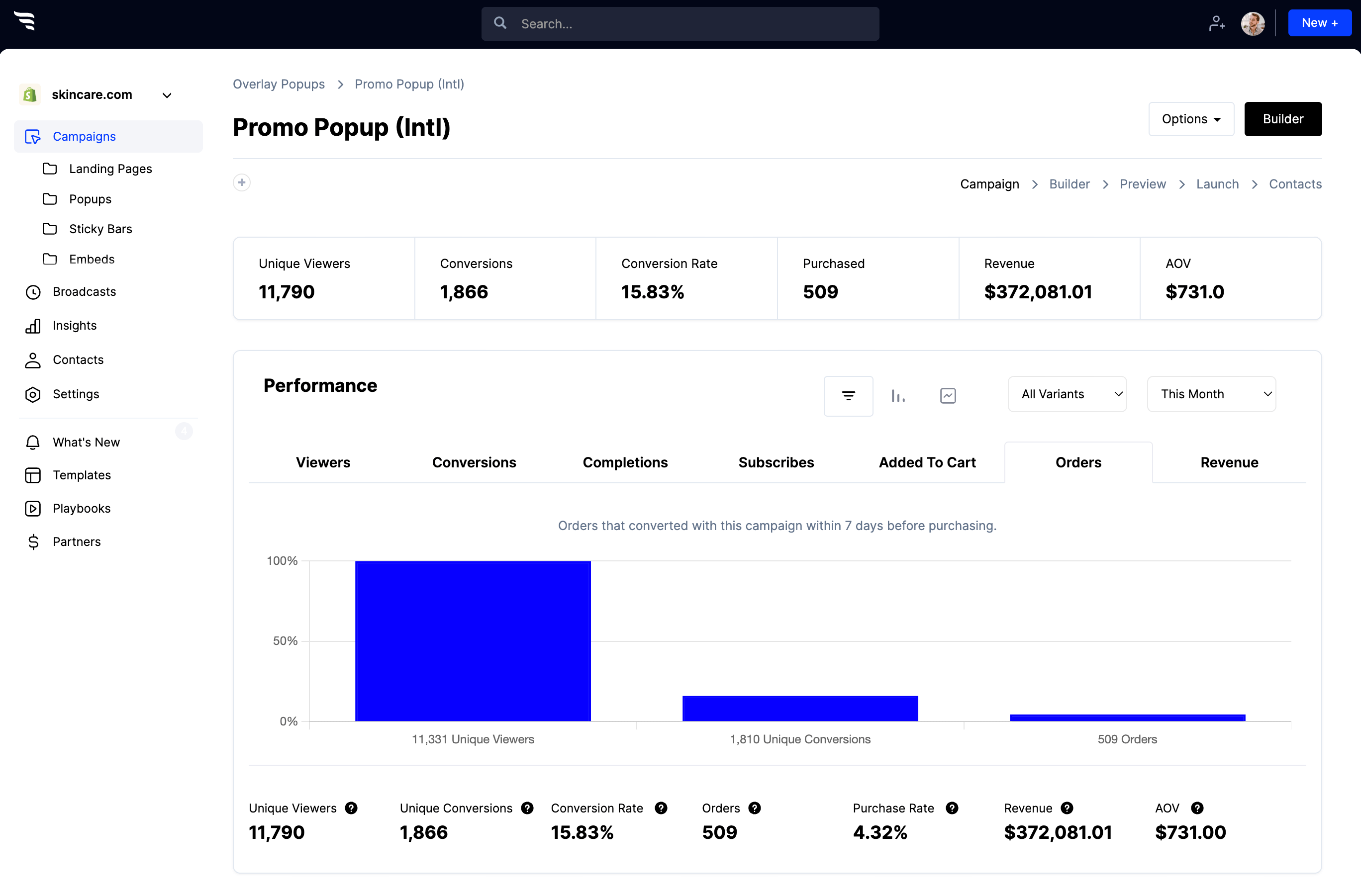
Add a parameter to every quiz-driven session and carry it through checkout. Now you can compare quiz-takers to non-quiz visitors on conversion rate, average order value, and repeat purchase rate. Don't rely on the quiz app's dashboard alone for attribution.
Quiz Funnel Benchmarks by Ecommerce Category
Performance varies a lot by product category. Use these ranges to judge whether your funnel is genuinely underperforming or just sitting in the normal band for your vertical.
Skincare and diagnostic quizzes typically see 18-28% quiz start rates from landing pages, 55-70% question completion, and 14-22% recommendation-to-cart conversion. They benefit from strong perceived personalization—shoppers treat them as diagnostic tools and engage deeply.
Vitamin and supplement quizzes perform similarly, with 20-32% start rates and 50-65% completion. The health angle makes people invested in seeing accurate results.
Apparel sizing quizzes show lower completion at 40-55% because the questions feel mundane rather than self-discovering. But their recommendation-to-cart rate is higher, at 18-28%, because someone who finishes a sizing quiz is usually ready to buy.
Common Quiz Funnel Mistakes That Hurt Conversion
Beyond the structural drop-off points, a handful of mistakes quietly drag quiz performance down.
Brand-First Copy Instead of Customer-First
Quizzes that read like brochures instead of conversations push shoppers away. Count how often your quiz says "we" versus "you." If "we" wins, rewrite from the customer's point of view.
Jargon and Technical Language
Category jargon alienates shoppers who aren't experts. "What's your main skin concern?" is answerable. "Which dermatological presentation affects your purchase decisions?" is not. Write questions the way your best sales associate would ask them out loud.
Inconsistent Design
A quiz that looks like it belongs to a different company breaks trust instantly. Colors, fonts, and styling should match your store's branding. ConvertFlow's quiz builder lets you style quizzes to match your brand without custom code.

Skipping Mobile Optimization
More shoppers complete quizzes on mobile than on desktop. Test explicitly on iOS Safari and Android Chrome. Check that image-based questions display correctly on small screens and that CTAs are tap-friendly.
No Incentive on Results Page
A 10-15% discount on the results page rewards completion and removes the final barrier between recommendation and purchase. For premium brands, a dollar-amount discount often converts better than a percentage. Test both.
Self-Audit Checklist for Your Ecommerce Quiz Funnel
Run your own quiz through these questions. Each "no" is a conversion opportunity you haven't claimed yet.
- Does your opening question speak to the customer's problem rather than your product line?
- Does your results page show 1-3 products on a single page instead of overwhelming options?
- Is your quiz between 6 and 12 questions?
- Are answer choices in plain language with 3-6 options per question?
- Have you tested all common answer combinations end-to-end on mobile?
- Does your quiz match your store's typography, colors, and button styles?
- Is the quiz a primary CTA on your homepage and navigation?
- Are your results-page buttons action-oriented like "Add to Cart" rather than generic "Continue"?
- Do you capture email and sync answers to your CRM?
- Does completing the quiz trigger a personalized follow-up email?
- Do you offer a discount or incentive on the results page?
In Conclusion: Building Quiz Funnels That Convert
Fixing ecommerce quiz funnel drop-off isn't one big change. It's working through the predictable points where shoppers lose momentum, in the right order. Start by instrumenting step-level tracking so you know where your specific funnel leaks. Then take each zone in revenue-impact order.
The entry screen has to reduce uncertainty fast. The question sequence needs progress signals that keep momentum. The email gate needs to feel like a fair exchange. The recommendation page needs to close the sale with confidence.
This is the exact playbook we run with ecommerce teams inside ConvertFlow, which gives you step-level reporting and A/B testing built in—so you can see precisely where shoppers drop off and test individual elements without breaking the rest of your funnel.
And the gains compound. A quiz funnel that completes at 60% instead of 40% delivers 50% more shoppers to your recommendation page. If that page converts 15% of them, that's real revenue from traffic you're already paying for.
FAQs about How to Fix Ecommerce Quiz Funnel Drop Off in 2026
What is a good quiz completion rate for ecommerce?
A strong quiz completion rate ranges from 55-70% depending on your product category. Skincare and supplement quizzes tend to hit the higher end because shoppers perceive strong personalization value. If your completion rate sits more than 15 points below these benchmarks, the gap is structural and requires design changes beyond simple question rewording.
How many questions should an ecommerce quiz have?
The optimal range is 6-12 questions for most ecommerce categories. Quizzes under 5 questions feel superficial and don't build enough trust for shoppers to believe the recommendation is personalized. Quizzes over 13 questions create fatigue without proportional recommendation accuracy gains. ConvertFlow's quiz builder supports any length with conditional logic to personalize the path.
Should I put the email capture before or after quiz results?
It depends on your primary goal. Email capture before results grows your list faster but loses 30-50% of quiz completers. Capture after results converts more shoppers to purchase but collects fewer emails. If immediate revenue is your priority, gate after results. ConvertFlow lets you test both positions to find what works for your audience.
How do I track where shoppers drop off in my quiz funnel?
Set up step-level event tracking in your analytics platform. Most quiz apps expose these events. If yours doesn't, instrument manually. ConvertFlow's funnel conversion reports show progression between steps, plus survey and quiz reports that reveal which answer combinations lead to purchase.
Why do shoppers abandon quizzes at the first question?
First-question abandonment happens when the screen fails to reduce uncertainty. Shoppers need to know how long the quiz will take, what format their answers should be in, and how this first question connects to the promised result. Adding visible step counts, format examples, and framing copy addresses these concerns.
How can I improve my quiz recommendation page conversion?
Treat your recommendation page like a product page rather than a quiz result screen. Limit recommendations to 1-3 products, show confidence in your suggestions without hedging language, use action-oriented CTAs like "Add to Cart," and include a discount to remove the final purchase barrier. ConvertFlow enables conditional product recommendations based on quiz answers.




.svg)
